
A knot in the thread
Picture a single golden thread running through the centre of your body, from the root lotus to the crown of your head. Now picture it tied, in three places, into small, tight knots. Something can flow up the thread, but only so far. At each knot it slows, pools and turns back.
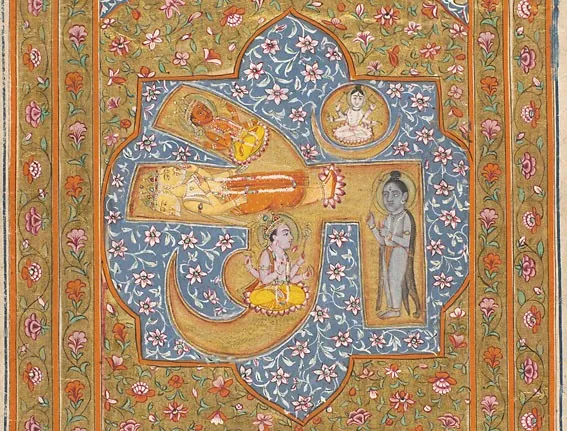
That is roughly what the yogis meant by the granthis. The word simply means “knot”, the ordinary word for a knot tied in a cord. There are three of them, named after the three great gods of the Hindu world: Brahmā the creator, Viṣṇu the preserver and Rudra, the fierce form of Śiva who dissolves.
The names are not decoration. Each knot binds us to something those gods stand for. The first ties us to the physical world and our survival in it. The second ties us to feeling, attachment and keeping things as they are. The third ties us to the mind itself, to the sense of being a separate someone who knows.
The traditions speak of Kuṇḍalinī, the Goddess, “piercing” or “breaking” these knots as she rises. It is a strong image, and a true one. But over the years we have come to read it alongside a softer one: a knot that is understood can also be untied.
Why these three gods
Brahmā, Viṣṇu and Rudra are the classical three faces of cosmic activity: making, keeping and unmaking. To find them tied into the human body is a very Tantric thought. Whatever happens in the cosmos happens in us, and the forces that build a universe are the same ones that hold a personality together.
Seen that way, each knot is a place where creation, preservation or dissolution has got stuck. Brahmā’s knot is the urge to exist, to have a body and keep it fed and safe. Viṣṇu’s knot is the urge to sustain what we love: our relationships, our story, our idea of who we are. Rudra’s knot is subtler. It is the last holding at the level of mind, the quiet conviction that there is an “I” standing apart from everything it perceives.
Arthur Avalon, writing in 1919, put the idea in one line. The knots, he said, are the points “where the force of Māyā Śakti is in great strength”. Māyā is the power that veils and measures out the infinite into the finite. At the knots, that veiling is thickest.
Where are they?
Ask a modern Kuṇḍalinī teacher and you will usually hear a tidy answer: Brahmā’s knot sits at the root centre, Viṣṇu’s at the heart and Rudra’s between the eyebrows. That scheme is clear and useful, and you will find it in many good books from the last hundred years.
Avalon himself gives a version of it. In The Serpent Power he places the knots at the Mūlādhāra, the Anāhata and the Ājñā, the three centres that hold the three liṅgas of Śiva: the Svayambhū-liṅga at the root, around which Kuṇḍalinī lies coiled, the Bāṇa-liṅga in the heart and the Itara-liṅga between the brows.
The older haṭha text is less tidy, and it is worth being honest about that. The Haṭha Yoga Pradīpikā, written by Svātmārāma in the fifteenth century, mentions the knots twice. In its chapter on breath it praises bhastrikā, the bellows breath, because it breaks the three knots, and Pancham Sinh’s 1914 translation adds small notes in brackets: Brahmā’s knot “in the chest”, Viṣṇu’s “in the throat”, Rudra’s “between the eyebrows”. In its last chapter it describes the knots as part of four stages of inner listening, and there the translation again places the knot of Brahmā in the heart and the knot of Viṣṇu in the throat. The knot of Rudra gives way when the breath reaches the seat of the Lord, which the third stage has just placed in the void between the eyebrows.
Those brackets are worth a moment. They come from the translator, guided by the Sanskrit and its commentators, not from a neat list in the verse itself. The Sanskrit speaks of spaces called “empty”, “very empty” and “the great void”. Locating those spaces in the chest, throat and brow is already interpretation, though it is old and careful interpretation.
The Lalitā Sahasranāma, the thousand names of the Goddess, gives yet another order. This hymn belongs to the Brahmāṇḍa Purāṇa, where the horse-headed Hayagrīva teaches it to the sage Agastya. A run of names, from about the ninety-ninth to the hundred-and-eleventh, follows Kuṇḍalinī’s whole ascent. She dwells in the Mūlādhāra and breaks the knot of Brahmā. She rises at the Maṇipūra and breaks the knot of Viṣṇu. She dwells in the Ājñā and breaks the knot of Rudra. Then she mounts the thousand-petalled lotus and rains down nectar. A few names later she is called Kuṇḍalinī outright, “fine as the fibre of a lotus stalk”.
| Source | Brahmā | Viṣṇu | Rudra |
|---|---|---|---|
| Haṭha Yoga Pradīpikā (Pancham Sinh) | Heart / chest | Throat | Between the brows |
| Lalitā Sahasranāma | Above the root | Above the navel | Brow |
| Avalon, The Serpent Power | Root | Heart | Brow |
| Modern popular scheme | Root | Heart | Brow |
So which is right? We would gently say: all of them, as maps. A knot is not a physical lump you could find on a scan. It is a place where consciousness is bound, and different lineages noticed those places from different angles. What every source agrees on is the order. Brahmā first, then Viṣṇu, then Rudra. Body, heart, mind.
The four stages of sound
The Pradīpikā’s account is worth reading slowly, because it ties the knots to something you can actually notice: inner sound, nāda. It names four stages, ārambha (the beginning), ghaṭa (the vessel, or union), paricaya (familiarity) and niṣpatti (completion).
In the beginning stage, the knot of Brahmā is pierced through prāṇāyāma. A bliss arises from the void, and the unstruck sounds are heard inside the body like the tinkling of ornaments. The text adds that the practitioner becomes radiant and free of illness.
In the second stage the breath unites and enters the middle channel. The posture becomes firm. The knot of Viṣṇu is pierced, and a deeper sound appears, like a kettledrum.
In the third stage the sound of a drum arises in the void between the eyebrows, and the mind is drawn into a great stillness.
In the fourth, the knot of Rudra gives way, the breath reaches the seat of the Lord, and the sound becomes like a flute. Mind and sound become one.
What we love about this sequence is its humility. It does not promise fireworks. It describes a gradual refinement of listening, from the noisy to the subtle, until the listener and the heard are no longer two. A little later the same chapter gives the practical advice that goes with it: when the loud sounds come, practise with the subtle ones as well, moving between them until the mind settles. Like a bee drinking nectar, it says, the absorbed mind no longer cares for the scent of the flower.
What it feels like when one loosens
In our own work with people the descriptions are rarely as clean as the texts, and that is fine. The texts are maps drawn by people who sat for decades. Real lives are messier.
The loosening of the first knot often shows up as a deep, almost physical relief, as if the body finally believes it is safe. People sometimes notice that they sleep differently, eat more simply, stop bracing against the day.
The second can come as grief, tenderness and a softening around old loyalties. Things we held on to for years, a role in the family, a story about who wronged us, a way of being needed, start to feel lighter. It can be uncomfortable. Something that preserved us is letting go.
The third is quieter. Something that always stood a little behind your eyes, watching and commenting, simply rests. Thoughts still come. They are just not you anymore, or not only you.
The knots are not enemies. Each one was tied, at some point, to keep us safe.Golden Sight Institute
We would add one honest observation from years of sitting with people. The knots rarely open in the textbook order. Someone may feel the heart soften long before the body feels safe, or glimpse the stillness of the third knot in a single meditation and then spend years on the first. The maps describe the general direction of travel. They are not a checklist.
None of this happens on a timetable, and none of it happens only once. A knot that seemed open can tighten again under stress. That is not failure. It is how living things work.
Working with the knots, not against them
It is tempting to treat the granthis as obstacles to be blasted through. The texts do speak of piercing them, and the Pradīpikā recommends forceful practices such as bhastrikā for exactly that purpose. But in practice the knots open the way a fist opens: when it no longer needs to hold on.
It helps to see how the haṭha authors thought the forceful methods worked. In Pancham Sinh’s translation, bhastrikā “destroys phlegm and the impurities accumulated at the entrance of the Brahma Nâdî”, and only then is it said to break the knots. In the chapter on the mudrās, the root lock is said to warm the sleeping Kuṇḍalinī until she wakes and enters the Brahma-nāḍī “just as a serpent enters its hole”. The logic is purification first: clear the way, warm the body, steady the breath. The piercing is the result, not the method.
We find that reassuring. Even in the most physical of the old manuals, nobody is told to attack a knot. You prepare the ground, and the Goddess does the rest.
For the knot of Brahmā that means grounding, steady routines, enough sleep, real food and a body that feels at home on the earth. Simple standing and walking practices, and a slow out-breath of 7 or 8 counts, do more here than any heroic technique.
For Viṣṇu it means honest work with the heart, including the old protective patterns that once kept us from being hurt. Devotion helps. So does talking with someone you trust, and sometimes with a good therapist.
For Rudra it means meditation, inner listening and the slow discovery that you are not your thoughts.
A word of care about the forceful methods. Bhastrikā, long breath retentions and strong bandhas are traditionally taught in person, step by step. Leave them aside if you are pregnant, or have high blood pressure, heart disease, glaucoma, epilepsy, a hernia or recent surgery, or a history of panic, psychosis or bipolar disorder, and check with your doctor before starting any of them. If practice ever brings sleeplessness, fear or confusion that does not settle, stop, ground yourself, and see a doctor or mental-health professional.
The mercy of the knots
None of this is fast. That is part of the mercy of the knots. They keep the power from rising before the body and the heart are ready to hold it.
The Pradīpikā says the lotuses and knots are pierced when Kuṇḍalinī wakes “by favour of a guru”. We take that seriously. The work of untying belongs to us: the breath, the listening, the honesty. The opening itself is given.
So be patient with your knots. They were tied by wise forces, for good reasons, and they will loosen in their own time.
Sources & further reading
- Svātmārāma, Haṭha Yoga Pradīpikā, trans. Pancham Sinh (1914). Verse numbers can differ by one between editions. Read online
- Svātmārāma, Haṭha Yoga Pradīpikā ch. 2, trans. Pancham Sinh (1914): bhastrikā and the three knots, verses 66–67 in his numbering. Read online
- Svātmārāma, Haṭha Yoga Pradīpikā ch. 4, trans. Pancham Sinh (1914): the four stages, verses 69–76. Read online
- Lalitā Sahasranāma, names on the three granthis. Read online
- On the Lalitā Sahasranāma and the Brahmāṇḍa Purāṇa. Read online
- Arthur Avalon, The Serpent Power, Introduction ch. 5. Read online
- Pūrṇānanda, Ṣaṭ-cakra-nirūpaṇa (1577), trans. Arthur Avalon in The Serpent Power (1919). Read online