
One goddess, many doors
Walk into almost any yoga studio and you will find a timetable that looks like a menu: flow, yin, power, Iyengar, Kundalini, restorative. They can look like flavours of the same thing. In one sense they are. In another, they are very different ways of approaching the same mystery, and they meet Kuṇḍalinī from different directions.
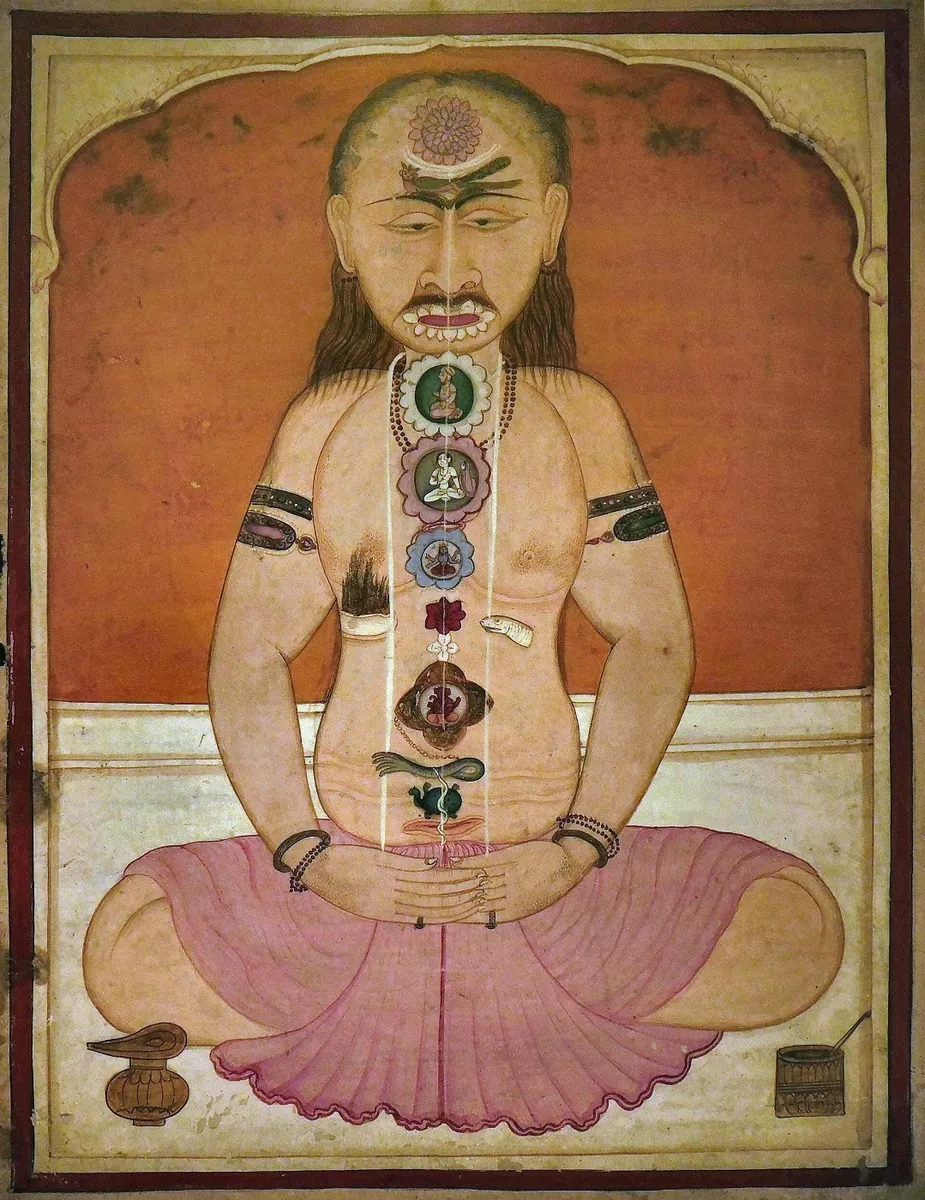
The old picture is the same in all of them. She lies coiled three and a half times in the root lotus, around the Svayambhū-liṅga, with her mouth covering the door of the central channel. What changes from school to school is how that door is meant to open. Some schools build heat and pressure below until she wakes and climbs. Some wait for a power that comes down from above, by grace. Some do neither, and simply rest attention in the heart, trusting that she will find her own way home.
Those three directions, rising, descending and resting, make a useful map. No tradition fits neatly into one box, and some deliberately use all three. But if you know which way a practice tends to move her, you can choose more wisely, and you can tell sooner when something is moving too fast.
Rising from below: haṭha and its heirs
The classical haṭha manuals are frankly upward. The Haṭha Yoga Pradīpikā, written in the fifteenth century, opens its third chapter by calling Kuṇḍalinī the support of all yoga. It lists ten mudrās for waking her, and it describes her as the key that opens the door to liberation. A little later comes a famous double-edged line: the same sleeping śakti that binds the ignorant is what frees the yogi. Then come the methods of śakti-cālana, stirring the power, with pressure at the kanda, bellows breathing and the drawing in of the navel, after which prāṇa is said to enter the suṣumnā.
This is strong medicine. It was written for renunciates living with a teacher, not for people squeezing a class in before work.
B.K.S. Iyengar stands in this lineage, though his own emphasis was alignment and care. In Light on Prāṇāyāma (1981) he describes Kuṇḍalinī as divine cosmic energy, a serpent of three and a half coils, and says the purpose of prāṇāyāma is to arouse her. He also says, and this matters, that she is awakened by the grace of God and of the guru. Even in this most methodical of schools, the last step is not under our control.
Ashtanga Vinyasa and the power yoga styles that grew out of it use mūla-bandha and uḍḍīyāna-bandha throughout the practice, linked to strong breath and continuous movement. They generate a great deal of heat. In our view, that heat and intensity can stir energy in sensitive people, and a fast-paced class rarely includes the long, quiet sitting that would give it somewhere to settle. That is not a criticism of the style. It is an observation about the container.

Rising from below: kriyā and the modern schools
Kundalini Yoga as taught by Yogi Bhajan (1929–2004) and his organisation 3HO brought these upward methods to a mass audience from the late 1960s. Classes are built around kriyās, set sequences of posture, breath, mantra and sound. Breath of Fire, a rapid rhythmic breath from the belly, and the Ego Eradicator, with the arms raised and the thumbs pointing up, are well-known examples.
The history needs stating plainly. In August 2020 an independent firm, An Olive Branch, published a report commissioned within the community. It heard from 299 people and found it more likely than not that Yogi Bhajan had sexually abused women in his circle. Since then, teachers and students have had to decide for themselves how to hold the practices apart from the man who taught them. Some have left. Some have kept the techniques and dropped the lineage claims. It is a live question, and we think it should be left to each person’s conscience.
Kriya Yoga, from Lahiri Mahasaya (1828–1895) and later Paramahansa Yogananda, works more inwardly. In Autobiography of a Yogi (1946), Yogananda describes the practitioner mentally guiding the life current upward and downward around the six spinal centres. He claims that half a minute of this practice is equal to a year of natural spiritual unfoldment. That is a large claim, and we report it as his, but the image of a gentle circling current is a beautiful one.
Swami Satyananda’s Kundalini Tantra (Bihar, 1984) is the great integrator of this side of the map. He combines chakra practices, haṭha purification and twenty practices of Kriya Yoga into a graded system. And he is cautious. Begin with purification, he says, not with the advanced methods. His blunt summary is worth remembering: without a guru you can practise any form of yoga, but not kundalini.
Descending by grace
A second family of paths starts from the other end. Here the awakening is a gift, given from above or through a teacher, and the practice is what you do with it afterwards.
The clearest example is śaktipāta, the descent of power. In the twentieth century it was offered widely by Swami Muktananda (1908–1982) of Siddha Yoga, who said he received it from his own teacher, Bhagawan Nityananda, in 1947. Thousands of people reported awakenings in his presence. There were also serious later allegations of sexual misconduct, published by William Rodarmor in 1983 and in The New Yorker in 1994. Grace, it seems, can pass through people who are not themselves whole. That is a hard lesson, and an important one.
Kashmir Śaivism, the tradition of Abhinavagupta around the year 1000, holds both directions at once. It speaks of ūrdhva-kuṇḍalinī, the rising power of expansion, and adhaḥ-kuṇḍalinī, the descending power of contraction into form. In Swami Lakshman Joo’s reading there are three aspects: śakti-kuṇḍalinī, lying latent at the heart; prāṇa-kuṇḍalinī, the rising breath-power; and parā-kuṇḍalinī, the supreme form at the crown. Lilian Silburn’s 1988 study remains the best way in for English readers.
The wider Tantric world is where Kuṇḍalinī first took shape as a goddess. The word itself possibly first appears in the Tantrasadbhāva, an eighth-century text, and she is central to the Śākta Kaula schools, especially those devoted to the goddess Kubjikā, “the crooked one”, whose very name echoes the coil.
Sri Aurobindo’s Integral Yoga is the most explicit about descent. He did not ask students to work on the chakras at all. The centres, he wrote, open of themselves by the descent of the Force. The practitioner’s part is aspiration and surrender, and the Force comes down from above, into the mind, the heart and finally the body. Sahaja Yoga, with its awakening given first, belongs broadly in this family too.
Resting in the heart
The third family barely mentions Kuṇḍalinī at all, and yet many teachers would say it is the safest path of the three.
Bhakti, the yoga of devotion, purifies the emotions before anything else. Satyananda calls karma and bhakti comparatively safe and mild methods for exactly this reason. When love has softened the heart, an awakening has a gentler place to land.
Ramana Maharshi, the great sage of Tiruvannamalai, took the path of jñāna, of knowledge and self-enquiry. In one of his recorded talks he says that raising Kuṇḍalinī to the crown is not the end, because the yogi comes back out of that samādhi. Lasting realisation, he says, comes when she returns to the Heart, and self-enquiry brings this about by itself. So for Ramana, the heart is both the starting point and the destination, and the long climb is optional.
And then there is Patañjali. The Yoga Sūtras, compiled around the fourth or fifth century CE and often treated as the root text of all yoga, never use the word Kuṇḍalinī. Not once. They speak of stilling the movements of the mind, of concentration, meditation and absorption. Some later commentators read Kuṇḍalinī into the text. But the silence itself is a teaching: it is entirely possible to walk a full yogic path without ever thinking about her.
The softer forms
Gentle yoga, restorative yoga and yin yoga do not usually talk about Kuṇḍalinī. They are designed to slow things down: long supported holds, bolsters, blankets, soft breath. In our view they are some of the most useful tools there are for anyone in a strong phase. When the nervous system is overloaded, the last thing it needs is more heat. A restorative class, a warm bath and an early night can do more for an over-stirred system than any advanced technique.
This is not glamorous advice. It works.
Choosing a path and a teacher
A few honest questions can help you choose.
What is your temperament? If you are fiery, driven and already prone to overdoing things, a hot and fast practice may feed the wrong side. If you are heavy, tired or low, a little more heat and movement may be just right. Notice which way you lean.
What is your life like right now? A demanding job, a new baby, a bereavement or a period of poor mental health are all reasons to choose gentleness. The power is patient. She will wait.
Does the teacher know this territory? Many excellent yoga teachers have no training in energetic awakening, and that is fine as long as they know it. Ask what they do when a student has a strong reaction. A good answer is calm and practical. A vague answer, or a thrilled one, is a warning.
Can you ask questions? Any teacher or group that discourages questions, demands secrecy or makes leaving difficult is not a safe container, however powerful the practice. The scandals around some famous teachers are a reminder that power and integrity do not always arrive together.
Satyananda, Aurobindo and Ramana come from very different traditions, but they agree on one thing: do not force her. That is as good a rule as any we know.
When a style stirs more than you can hold
Sometimes a practice works too well. You might notice heat in the spine, shaking, waves of emotion, insomnia, racing thoughts, pressure in the head, or a sense of unreality that lingers after class. These can be signs of energetic activation. They can also be signs of something medical or psychological, and the two can look alike.
So first, see a doctor, and if your mood, sleep or sense of reality is affected, see a mental-health professional as well. That is not a betrayal of the spiritual path. It is part of looking after the body that carries it.
Then, simplify. Stop the strongest practices first: rapid breathing such as kapālabhāti, bhastrikā and Breath of Fire, long breath retentions, strong bandhas and intense chakra visualisations. These are not advised in pregnancy, with high blood pressure or heart conditions, with epilepsy, after recent abdominal surgery, or with a history of psychosis, and they are worth pausing whenever things feel too much.
Ground yourself. Eat warm, simple food. Walk, ideally on earth or grass. Sleep at regular times. Spend time with people who know you. If you breathe consciously at all, let the out-breath be long and slow, an out-breath of 7 or 8, and let the in-breath come by itself.
Move towards the softer forms for a while: restorative yoga, gentle walking, devotion, quiet sitting with eyes open. And find someone experienced to talk to, a teacher who has walked this ground and can see you clearly.
Most of all, be kind to yourself. When she stirs more than you can hold, it does not mean you have failed or that you are broken. It means you need a slower pace and a wider container. She is in no hurry. You need not be either.
Sources & further reading
- Svātmārāma, Haṭha Yoga Pradīpikā, trans. Pancham Sinh (1914). Verse numbers can differ by one between editions. Read online
- Abhinavagupta, Tantrasāra and Tantrāloka ch. 5; notes by Mark Dyczkowski. Read online
- Lilian Silburn, Kuṇḍalinī: Energy of the Depths, SUNY Press, 1988
- Lakshmanjoo Academy, on automatic recitation (VBT 155–156). Read online
- Wikipedia, Yogi Bhajan, on the An Olive Branch report (August 2020). Read online
- Paramahansa Yogananda, Autobiography of a Yogi (1946), chapter 26, “The Science of Kriya Yoga”
- B.K.S. Iyengar, Light on Prāṇāyāma (1981)
- Talks with Sri Ramana Maharshi, talk 616
- Sri Aurobindo, letters on the Integral Yoga and the chakras. Read online
- Swami Satyananda Saraswati, Kundalini Tantra (Bihar School of Yoga, 1984)