
Try this now
Hold the back of your hand just under your nose and breathe out gently through the nose. Or press one nostril closed with a finger, breathe a few times, then try the other side. Chances are that one side flows more freely than the other. Come back in an hour or two and it may well have switched.
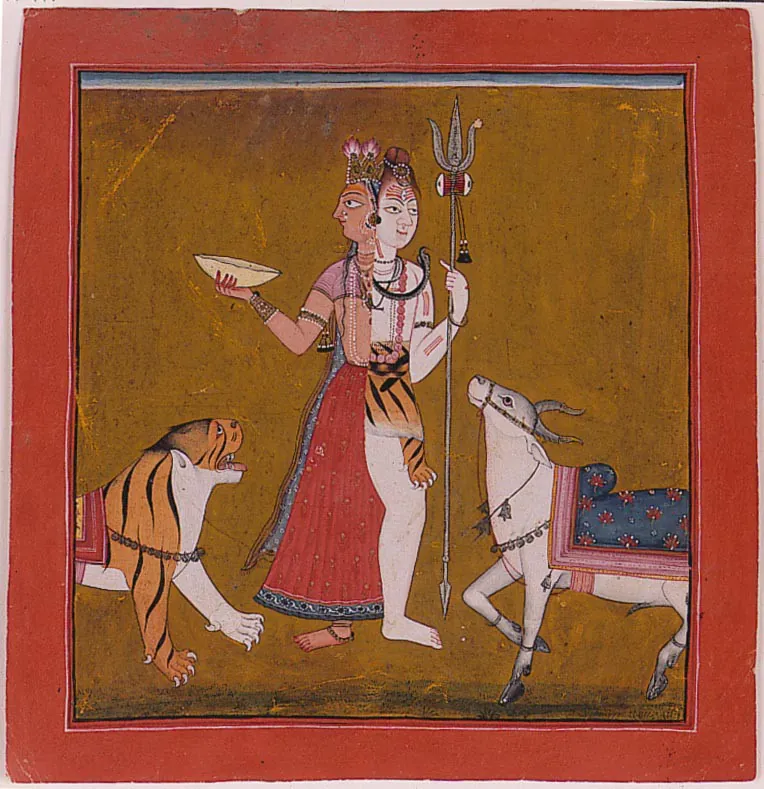
Most of us never notice this. The yogis noticed it centuries ago and built a whole art around it, called svara, the science of the breath. Its classic text is the Śiva Svarodaya, written, like many tantras, as a conversation between Śiva and the Goddess. In a few hundred verses it teaches how to read the flow of breath in each nostril, and what to do with what you find.
In this piece we look at what the tradition says, what modern physiology has found, where the two agree and where they part, and how to use all of this in a gentle, practical way.
What the body is doing
Modern medicine calls this the nasal cycle. In the Western literature it was first described by the German physician Richard Kayser in 1895. Inside each side of the nose are the turbinates, curled shelves of tissue rich in blood vessels. Over time one side swells a little with blood and narrows, while the other shrinks and opens. Then they trade places.
The rhythm is governed by the autonomic nervous system, the part of us that runs without being asked. An early study by Heetderks in 1927 observed it in about eighty per cent of a normal population, and a commonly cited average for one full cycle is around two and a half hours, though it varies with age, posture and many other conditions. Interestingly, the total resistance of the nose stays roughly constant. The airflow does not rise and fall; it simply moves from side to side.
Posture matters too. When you lie on your side, the tissue in the lower nostril tends to fill, and the upper nostril tends to open. Keep that in mind; we will use it later.
So the basic observation of the svara yogis is sound. There really is a tide in the nose, and it really does turn.
Moon on the left, sun on the right
For the yogis, the two nostrils are the outer ends of two great channels of the subtle body. The Ṣaṭ-cakra-nirūpaṇa opens its first verse with this picture: outside the Meru, the spine, on the left is Śaśī, the moon, and on the right is Mihira, the sun, with the suṣumnā between them. The left channel is iḍā, lunar, cool and receptive. The right is piṅgalā, solar, warm and active. The suṣumnā in the middle is fiery and red.
The Haṭha Yoga Pradīpikā uses the same language very practically. It simply calls the left nostril candra, the moon, and the right one sūrya, the sun. Elsewhere it places the sun in the body above the navel and the moon below the palate. And it gives the two channels the names of the holy rivers: iḍā is the Gaṅgā, piṅgalā the Yamunā, and between them, it says, lies Kuṇḍalinī.
That last image is worth holding. She lies coiled in the root lotus, around the Svayambhū-liṅga, covering the door of the central channel, with the two great rivers flowing on either side. While the breath swings between sun and moon, the door stays closed.
The Pradīpikā goes further still in its fourth chapter: time itself, in the form of day and night, is made by the sun and the moon. To bring the breath out of their alternation and into the centre is, in the poetry of haṭha, to step out of time.
What the Śiva Svarodaya teaches
The svara text works this out in detail. A few of its main teachings:
The flow changes roughly every hour. The text says each breath, moon or sun, flows for two and a half ghaṭikās. A ghaṭikā is twenty-four minutes, so that is about an hour. Modern measurements usually find a longer and less regular cycle. We would take the hour as an ideal rhythm, not a timetable.
The fortnight sets the starting point. According to the text, in the bright half of the lunar month the moon breath begins the day, and in the dark half the sun breath does, each holding for the first three lunar days. The text holds that when the breath at sunrise matches this calendar, the day goes well, which is why svara practitioners check their nostrils first thing in the morning.
The elements take their turns. Within each period, the text says, the five elements, earth, water, fire, air and space, rise one after another. Later commentators give each a number of minutes; the details differ between editions, so we will leave them aside.
Each breath suits different work. When the left, lunar breath flows, the text favours calm and lasting things: worship, giving, travel, beginning a study or an art, making friends. When the right, solar breath flows, it favours effort and force: hard physical work, difficult study, contests. Some activities appear under both, and you are meant to judge by their nature.
When both flow, it is time to sit. When the breath runs evenly through both nostrils, the suṣumnā is said to be active. The text advises against beginning worldly tasks then. It is a time for worship and meditation.
When both breaths flow as one, sit down. The door is open.After the Śiva Svarodaya
Why Kuṇḍalinī teachers care
The whole aim of the haṭha practices is to bring the breath out of its swing between left and right and into the centre. The Pradīpikā is direct about why: while the channels are clogged, it says, the breath cannot enter the middle way. And when the breath is disturbed, the mind is disturbed; when the breath is steady, so is the mind.
That is why nāḍī-śodhana, the purification of the channels by alternate-nostril breathing, comes first among its breath practices. In the text it is a strong practice: breath held after each inhalation, built up gradually to eighty rounds four times a day, over months. The Pradīpikā itself warns that the breath must be tamed slowly, like a lion, an elephant or a tiger, or it will harm the practitioner. We take that seriously, and what we offer below is a much gentler form.
Svara gives us something quieter still: a way to notice, through the ordinary day, how the sun and moon are moving in us. You do not have to do anything. You simply start to listen.
Warming and cooling the breath
The Pradīpikā also uses the two nostrils on their own. Its first named breath retention is sūrya-bhedana, the piercing of the sun: the breath is drawn in slowly through the right nostril, held, and let out through the left. The text says it cleanses the head and settles disorders of wind in the body. In the language of svara, it feeds the solar side.
Many modern teachers add a mirror image, a “moon-piercing” breath in through the left and out through the right, to calm and cool. It is a reasonable idea, but we should be honest that the Pradīpikā itself does not describe it. For the opposite quality, the tradition looks instead to two breaths drawn in through the mouth, śītalī and sītkārī, which later teachers treat as the cooling breaths; the name śītalī itself comes from śīta, cool.
We mention these so you can recognise them, not as homework. The retentions in these practices are strong medicine, and the old texts assume a teacher at your side. For everyday balancing, the gentle method below is enough.
What svara adds to all this is timing. Instead of forcing the sun or the moon, you first find out which one is already flowing. Very often the most useful thing is not to change the breath at all, but to let your activity follow it: quiet, steady work when the moon is up in you; vigorous work when the sun is; and stillness, if you can make room for it, when both are even. Try that for a week and see what you notice.
A gentle practice, step by step
Check the flow. Three or four times a day, on waking, before a meal, in the late afternoon, at bedtime, notice which nostril is more open. Close one side lightly with a finger and breathe; then the other. Note it without judging. A small notebook or a practice log helps; after a few weeks you may begin to see your own rhythm.
Notice the quality. When the left side flows, how do you feel? When the right side flows? Do not try to confirm the texts. Just observe. Some people find the old descriptions fit them closely; others find no pattern at all. Both are honest results.
Balance with alternate-nostril breathing. Sit upright. Rest the left hand on the knee. With the right hand, fold the index and middle fingers into the palm and use the thumb for the right nostril and the ring finger for the left.
- Breathe out fully. Close the right nostril and breathe in through the left for a count of 4.
- Close the left, open the right, and breathe out slowly for a count of 7 or 8.
- Breathe in through the right for 4.
- Close the right, open the left, and breathe out for 7 or 8.
That is one round. Do eight to ten rounds, with no breath-holding, then let both hands rest and breathe naturally for a minute. If a long out-breath feels strained, shorten both counts until it is easy. Comfort matters more than numbers.
Shift the flow, if you wish. The simplest method follows the physiology. Lie on your left side for several minutes and the right nostril will tend to open; lie on your right side and the left will tend to open. Svara practitioners use this to bring on the breath suited to a task, or simply to restore balance.
When both flow, take the invitation. If you check and find both sides open and even, treat it as a small door. Sit for five minutes, even at your desk. Close your eyes and feel the breath meeting in the middle.
A light touch
We would not suggest planning your life around your nostrils. The svara texts come from a world very different from ours, and parts of them, the omens, the predictions of victory and death, the timing of journeys, are better read as poetry and as history than as instruction. Some modern claims go beyond the evidence too. You will often read that the left nostril is wired to the right half of the brain and the right to the left. A few small studies of forced one-nostril breathing found effects of this kind, but later research did not find a reliable link between the natural dominant nostril and the more active side of the brain. We hold that question open.
A word on health. A nose that is always blocked on one side is not a svara sign; it is worth seeing a doctor about, since it can have simple physical causes. Alternate-nostril breathing as described here is gentle, but if you are pregnant, have a heart or blood-pressure condition, or are in a very active phase of awakening, keep it soft and short, never add breath retention without a qualified teacher, and check with your doctor if you are unsure. Stop if you feel dizzy, and breathe normally.
And then enjoy it. The basic practice of noticing is beautiful. It turns something you do more than twenty thousand times a day without thinking into a small, living contact with the sun and moon inside you, and with the quiet door between them.
Sources & further reading
- Śiva Svarodaya. Read online
- Śivasvarodaya, Sanskrit text (Ambuda digital edition). Read online
- Svātmārāma, Haṭha Yoga Pradīpikā, trans. Pancham Sinh (1914). Verse numbers can differ by one between editions. Read online
- Pūrṇānanda, Ṣaṭ-cakra-nirūpaṇa (1577), trans. Arthur Avalon in The Serpent Power (1919). Read online
- On the nasal cycle: Kayser 1895, Heetderks 1927 and later research. Read online