
The serpent who sleeps
Today the word kuṇḍalinī turns up on yoga timetables and in podcast titles. It is easy to forget how carefully, and how reverently, the old texts speak of her. In the Tantric and haṭha traditions she is not a technique, and not a vague “energy” either. She is the Goddess herself, the power of consciousness, resting in the human body until she wakes.
Even the name tells you something. Kuṇḍala is a ring or an earring, anything curled round on itself. Kuṇḍalinī is “she who is coiled”, and the word is feminine all the way through. When English writers call her “it”, something has already been lost in translation.
She is not as old as some books claim. You will not find her in the early Upaniṣads. The name may first appear in a Tantra called the Tantrasadbhāva, from around the eighth century, and she becomes central in the Śākta Kaula schools that worshipped the goddess Kubjikā, “the crooked one”. From there she passed into the haṭha manuals, and from the haṭha manuals, many centuries later, into our world.
We think it helps to know this. A living tradition grows. Honouring her does not require us to pretend that every detail is ten thousand years old.
A Bengali text and an English judge
The most detailed portrait we have comes from a short Sanskrit text called the Ṣaṭ-cakra-nirūpaṇa, “the description of the six centres”. A Bengali teacher named Pūrṇānanda wrote it in 1577. It was never meant as a stand-alone book. It was one chapter of his larger Tantric work, the Śrītattvacintāmaṇi, and only later travelled on its own.
In 1919 Arthur Avalon translated it in The Serpent Power. Avalon was the pen name of Sir John Woodroffe, an English judge who sat on the High Court in Calcutta and became its Chief Justice. He did not work alone. He leaned heavily on Indian friends and teachers, among them A. B. Ghose, and he translated the verses together with a Sanskrit commentary by Kālīcaraṇa, which explains each image line by line.
That book is still the doorway most of us walk through, and it is worth knowing what kind of doorway it is. Woodroffe wrote in the formal English of his day. He chose “Serpent Power” for a feminine Sanskrit name. He kept many terms untranslated because he knew that words like śakti do not sit comfortably in English. “Power” is close. “Energy” is closer to physics than to worship. Neither quite carries the sense of a living Goddess who is also the very stuff of consciousness.
So when we read Avalon, we read through two layers at once: a sixteenth-century Bengali master and an Edwardian judge doing his honest best. We are grateful to both.
Coiled in the root lotus
Pūrṇānanda begins at the bottom. The first lotus, the Mūlādhāra, is attached to the mouth of the suṣumnā and placed, he says, below the genitals and above the anus. It has four crimson petals. Its earth region is a shining yellow square, and the elephant Airāvata carries the seed-syllable laṃ.
In the middle of that lotus there is a small triangle that shines like lightning, the sign of Śakti. Inside it stands the Svayambhū-liṅga, the self-born sign of Śiva. And around the liṅga, coiled three and a half times, lies Kuṇḍalinī.
Fine as the fibre of a lotus stalk, she shines like young lightning and murmurs like a swarm of bees.After Ṣaṭ-cakra-nirūpaṇa, verses 10–11
Her mouth gently covers the Brahma-dvāra, the door of Brahman, a small opening that leads into the innermost channel. While she sleeps that door stays closed and our attention flows out into the world. When she wakes, the door opens and she begins to climb.
Two more lines from the same verses are easy to skip, and we would ask you not to. Avalon’s translation calls her “the world-bewilderer”. It also says that it is she who keeps every being alive “by means of inspiration and expiration”. In other words, the sleeping Goddess is not idle. She is the power that breathes us, every moment, and the power that veils us from our own nature. The same one who binds is the one who frees.

Fifty letters of creation
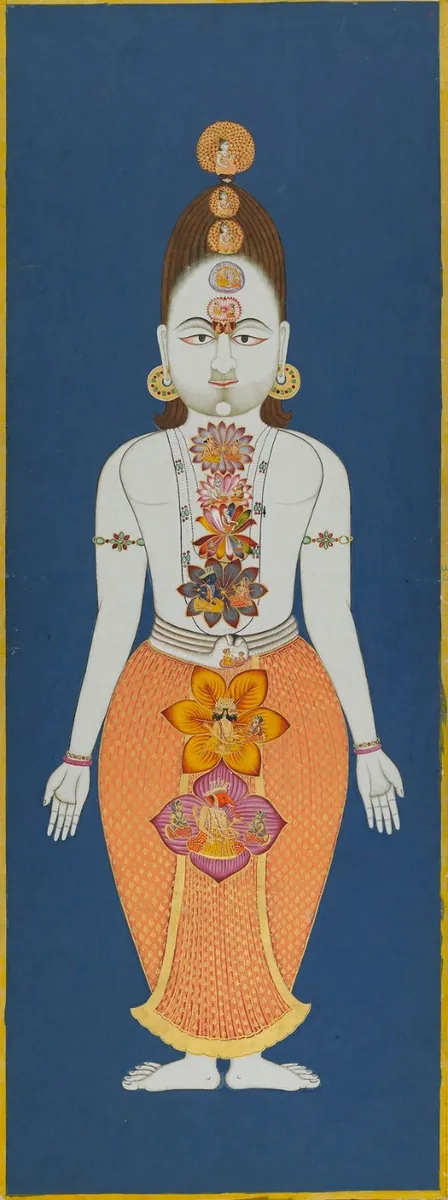
Each of the six centres is pictured as a lotus with a fixed number of petals, and on every petal sits a letter of the Sanskrit alphabet. The root lotus has four petals: va, śa, ṣa and sa. The next has six, the navel lotus ten, the heart twelve, the throat sixteen (all the vowels), and the lotus between the eyebrows two, ha and kṣa.
| Centre | Seat | Petals | Element | Bīja |
|---|---|---|---|---|
| Mūlādhāra | Between genitals and anus | 4 | Earth | laṃ |
| Svādhiṣṭhāna | Root of the genitals | 6 | Water | vaṃ |
| Maṇipūra | Navel | 10 | Fire | raṃ |
| Anāhata | Heart | 12 | Air | yaṃ |
| Viśuddha | Throat | 16 | Ether | haṃ |
| Ājñā | Between the eyebrows | 2 | Mind | oṃ |
Now add them up. Four, six, ten, twelve, sixteen and two make fifty, the number of letters in the Sanskrit alphabet as the Tantras count it. Above the head, the thousand petals of the Sahasrāra carry all fifty again, twenty times round.
We find this one of the most beautiful ideas in the whole tradition. In Tantric thought the world is spoken into being out of these sounds. So the body is not a container for the sacred. It is a living alphabet, the same speech that made the universe, laid out lotus by lotus along the central channel.
The colours are worth a moment too. Most of us picture the chakras as a rainbow, red at the root and violet at the crown. Pūrṇānanda saw them differently: a crimson root lotus, a vermilion second lotus, a navel lotus the colour of heavy rain-clouds, a heart lotus the red of the bandhūka flower, a smoky purple throat and a lotus between the brows white like the moon. The rainbow came in the twentieth century, and there is a separate article in this Journal on that story.
Seventy-two thousand channels
The Haṭha Yoga Pradīpikā, a fifteenth-century handbook by Svātmārāma, speaks of 72,000 openings of nāḍīs, channels of prāṇa, in the body. Then it says, almost in the same breath, that only one of them really matters: the suṣumnā. Other texts give other numbers. Avalon notes 300,000 in one Tantra and 350,000 in another. The exact count is not the point. The picture is of a body threaded through with light.
Two great currents wind around the centre. Iḍā runs on the left, lunar and cooling. Piṅgalā runs on the right, solar and warming. Pūrṇānanda opens his whole text with them: the moon on the left of Meru, the sun on the right, and suṣumnā between. His commentator explains that Meru, the world mountain, is the backbone. The two currents end at the nostrils, which is why the breath is the key to the whole system.
The suṣumnā is not a simple tube, either. Pūrṇānanda describes channels nested inside it like the layers of a stalk. Inside the fiery suṣumnā lies vajrā. Inside vajrā lies the pale citriṇī, “fine as a spider’s thread”. And inside citriṇī is the hollow Brahma-nāḍī, the actual path Kuṇḍalinī travels.
No wonder the practices of breath come first. The Pradīpikā says plainly that the breath does not enter the middle channel while the nāḍīs are impure, and that faithful practice of alternate-nostril breathing cleans them in three months and more. The Gheraṇḍa Saṃhitā gives the old proportion: one part in-breath, four parts holding, two parts out-breath, in its own measures of sixteen, sixty-four and thirty-two. Those long holds belong to advanced, supervised practice. For most of us the gentle version, with no holding at all and a slow out-breath of 7 or 8 counts, is already a deep cleansing.
What the Pradīpikā adds
Pūrṇānanda gives us the picture. Svātmārāma, a century and more earlier, gives us the method, and he is just as reverent. His third chapter, on the mudrās, opens with an image we love. Pancham Sinh’s 1914 translation puts it like this:
As the chief of the snakes is the support of the earth with all the mountains and forests on it, so all the Tantras (Yoga practices) rest on the Kuṇḍalinī.Haṭha Yoga Pradīpikā 3.1, trans. Pancham Sinh
The next verse says that when she wakes “by favour of a guru”, all the lotuses and all the knots are pierced. Note the phrase. Even in a manual full of physical technique, the awakening is placed in the hands of grace.
Later in the same chapter Svātmārāma lists her names: Kuṭilāṅgī, “the crooked-bodied”; Kuṇḍalinī; Bhujaṅgī, “the she-serpent”; Śakti; Īśvarī, “the sovereign”; Kuṇḍalī; and Arundhatī. These are not technical labels. They are the kind of names a devotee uses. Then come three verses that sum up the haṭha view. As a door is opened with a key, the yogi opens the door of liberation by means of Kuṇḍalinī. The Parameśvarī, the supreme Goddess, sleeps covering the passage to the seat of Brahman. And she sleeps above the kanda, the bulb from which the channels spring, “for the purpose of giving moksa to Yogîs and bondage to the ignorant”.
One small warning about verse numbers. They differ between editions. Pancham Sinh’s English numbering for that list of names is 3.97, while the Sanskrit numbering printed beside it, like many modern editions, runs seven verses higher, at 3.104. If a quotation seems to be missing, look a few verses either side.
The knots, the inner sound and the signs
On her way up, the power meets three knots, the granthis of Brahmā, Viṣṇu and Rudra. Here the sources honestly disagree. Avalon places them at the root, the heart and the brow, beside three liṅgas. The Pradīpikā describes them through four stages of inner listening, and its translator places the first knot in the heart, the second in the throat and the third between the eyebrows.
In the first stage a tinkling sound, like jewellery, is heard within. In the second the breath enters the central channel and a kettledrum sounds. In the third a drum resounds in the void between the eyebrows. In the fourth the last knot gives way, the sound becomes like a flute, and mind and sound melt into one.
The advice that follows is gentle and practical. When loud sounds come, practise with the subtle ones too; let go of the loud and take up the subtle, and back again, until the mind rests. It reads less like a technique than like the advice of someone who has sat for a very long time.
Around the year 1000, the great Kashmiri teacher Abhinavagupta described five signs that can appear as consciousness rises through the body. There is ānanda, bliss. There is udbhava, a sudden leap or upward surge. There is kampa, trembling. There is nidrā, a sleep-like stillness. And there is ghūrṇi, a whirling, all-pervading expansion. He offers these as signposts, not prizes. You notice them, you let them pass, and you keep going. Lilian Silburn’s study of the Kashmiri sources makes the same point again and again: what matters is the deepening of awareness underneath the signs.
Approaching her with reverence
Every one of these texts speaks of Kuṇḍalinī with awe. She is the most powerful transforming force a person can meet, and that is exactly why the traditions insist on patience, purification and a living teacher. The locks, the breath retentions and the deeper practices are learned step by step, from someone who has walked the road.
We say this from experience as well as from books. Our founder’s Kuṇḍalinī has been active for nineteen years, and much of what he teaches came from many teachers and many texts, tested slowly in his own life. What the old authors call grace is real. So is the need for grounding, sleep, good food and ordinary kindness while she works.
A practical word. Strong breath retentions and the bandhas are not for everyone. If you are pregnant, or have high blood pressure, heart disease, glaucoma, epilepsy, a recent operation, or a history of psychosis or bipolar disorder, leave them aside and speak to your doctor first. If awakening experiences bring sleeplessness, panic or confusion that does not settle, please see a doctor or mental-health professional. That is not a failure of faith. It is care for the body she lives in.
That is the spirit we try to work in at the Golden Sight Institute. We hold the old knowledge with respect, we say so when the sources differ, and we never forget that her awakening is, in the end, an act of grace.
Read slowly. Practise gently. Let her lead.
Sources & further reading
- Pūrṇānanda, Ṣaṭ-cakra-nirūpaṇa (1577), trans. Arthur Avalon in The Serpent Power (1919). Read online
- Svātmārāma, Haṭha Yoga Pradīpikā, trans. Pancham Sinh (1914). Verse numbers can differ by one between editions. Read online
- Svātmārāma, Haṭha Yoga Pradīpikā ch. 3, trans. Pancham Sinh (1914): verses 1–2 and 97–101 in his numbering. Read online
- Gheraṇḍa Saṃhitā, chapter 5. Read online
- Abhinavagupta, Tantrasāra and Tantrāloka ch. 5; notes by Mark Dyczkowski. Read online
- Lilian Silburn, Kuṇḍalinī: Energy of the Depths, SUNY Press, 1988
- Arthur Avalon, The Serpent Power, Introduction ch. 5. Read online
- Yogic Studies, The Ṣaṭcakranirūpaṇa: Description of the Six Cakras (on Pūrṇānanda and the Śrītattvacintāmaṇi). Read online
- On Sir John Woodroffe (Arthur Avalon), 1865–1936. Read online
- On the history of the chakra colours. Read online