
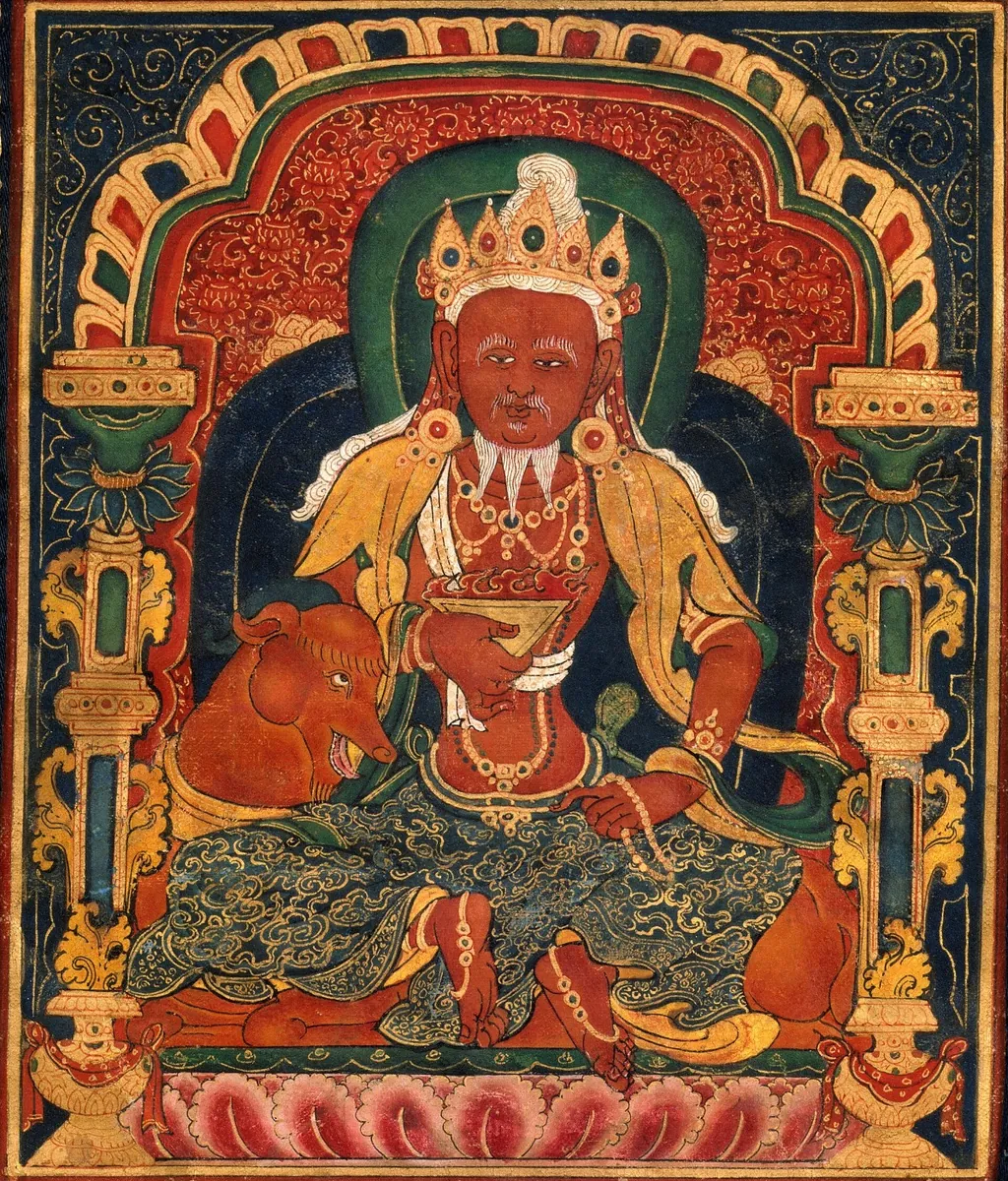
The heat that makes worlds
Before yoga had postures, it had heat. The old Vedic word is tapas. It comes from a root meaning “to burn” or “to warm”, and it came to mean the glow of discipline: fasting, vigil, silence, the effort of holding still while everything in you wants to move.
The Ṛg Veda puts tapas at the very start of things. In the hymn of creation (10.129), the One comes into being through the power of heat. Another late hymn opens with a line that Griffith rendered in 1896:
From Fervour kindled to its height Eternal Law and Truth were born.Ṛg Veda 10.190.1, trans. Griffith
In the Brāhmaṇas, Prajāpati heats himself with tapas before he creates. In the Taittirīya Upaniṣad, the young Bhṛgu is told again and again by his father to seek Brahman through tapas, and at one point he is told plainly that tapas is Brahman.
Patañjali kept the word. The Yoga Sūtras (2.1) open their second chapter by defining the yoga of action as three things: tapas, self-study and surrender to the Lord. Here tapas is no longer cosmic. It is the daily heat of a practitioner who keeps showing up.
So the idea is very old. The inner fire is not only something that burns away. It is something that brings forth. Every fire practice in this article stands somewhere in that long line, and every one of them can also burn the house down if it is handled carelessly. Both things are true.
The fire at the navel
In the Ṣaṭ-cakra-nirūpaṇa, the third lotus, Maṇipūra, is the region of fire. Inside its ten petals is a red triangle, the seat of the fire element, with the seed-syllable raṃ, and its carrier is a ram. Even the central channel is coloured by fire: Pūrṇānanda describes the suṣumnā as fiery, and hence red.
There is a lovely detail here. The lotus itself is not red. Pūrṇānanda gives its petals the colour of heavy rain-clouds, so the fire sits inside a dark, cool flower, like lightning in a monsoon sky. The haṭha texts also speak of the fire of the belly, the digestive fire, and many of their practices are said to strengthen it. For the yogis the fire that digests food and the fire that wakes the Goddess live in the same neighbourhood.
The Haṭha Yoga Pradīpikā gives this fire a job. In its account of mūla-bandha, the root lock (3.66–68 in the Sanskrit numbering; Pancham Sinh’s English runs one lower), apāna, the downward breath, is turned upward and enters the zone of fire. The flame, struck by the air, grows longer. Then comes the line every student of this text remembers:
The Kuṇḍalinî, which has been sleeping all this time, becomes well heated by this means and awakens well.Haṭha Yoga Pradīpikā 3.68, trans. Pancham Sinh
The text compares her to a serpent struck with a stick, who straightens and enters the Brahma-nāḍī. The image is fierce, and we do not take it as an instruction to strike anything. But it tells us how the haṭha yogis thought: breath, lock and fire work together, and the fire belongs at the navel, held in place by the locks above and below.
Skull-shining and the bellows
The Pradīpikā gives two fire breaths. The first, kapālabhāti, “skull-shining”, is listed among the six cleansing practices, not among the prāṇāyāmas proper.
When inhalation and exhalation are performed very quickly, like a pair of bellows of a blacksmith, it dries up all the disorders from the accumulation of phlegm.Haṭha Yoga Pradīpikā 2.35, trans. Pancham Sinh
That is all the text says, and it is worth noticing how little it is. No count, no posture, no promise of awakening. Kapālabhāti is a cleaning practice first.
The way most of us learn it today is more precise: a brisk, active out-breath through the nose as the belly draws in at the navel, and a passive in-breath that simply lets the belly fall back. B. K. S. Iyengar described it as a milder form of bhastrikā, and that is a fair way to hold it.
The second is bhastrikā, “the bellows” (HYP 2.59–67). Seated in padmāsana, the practitioner breathes forcefully in and out, both breaths active, like a blacksmith pumping air into the forge, until tired. Then comes a full in-breath through the right nostril, a retention with the locks, and an out-breath through the left. The text promises a great deal. It says bhastrikā balances the three doṣas and increases the digestive fire. And then:
It quickly awakens the Kuṇḍalinî, purifies the system, gives pleasure, and is beneficial.Haṭha Yoga Pradīpikā 2.66, trans. Pancham Sinh
It also clears the phlegm at the entrance of the Brahma-nāḍī and breaks the three knots, Brahmā, Viṣṇu and Rudra, which Pancham Sinh glosses as in the chest, the throat and between the eyebrows. The Gheraṇḍa Saṃhitā lists bhastrikā among its eight kumbhakas, and the Pradīpikā names it again in śakti-cālana, the practice of moving the power, where bhastrikā is done to rouse her.
Notice the word “quickly”. For the old yogis this was a promise. For many people living ordinary lives today, without a teacher in the next room, it is also a warning.

The modern Breath of Fire
The Breath of Fire taught in Kundalini Yoga as brought to the West by Yogi Bhajan is a modern form, related to kapālabhāti but not the same. It is done through the nose, light, even and rapid, often two or three breaths a second, with in-breath and out-breath equal in strength. The navel moves by itself rather than being pumped, and the chest stays relaxed and lifted. A usual round is one to three minutes, sometimes longer inside a set.
It is often paired with Ego Eradicator. The arms are raised to about sixty degrees, the fingertips curled onto the pads of the hand, thumbs pointing up, eyes closed and attention at the brow. To finish, you breathe in, touch the thumbs together overhead, breathe out and lower the arms slowly. It is also done with Spinal Flex, a seated rocking of the pelvis and spine, chest forward on the in-breath and back on the out-breath.
The difference from kapālabhāti matters in practice. In kapālabhāti the out-breath is the stroke and the in-breath is a rebound. In the Breath of Fire both are even, and the rhythm is lighter and faster. People who are used to one are often surprised by how different the other feels.
We should say one plain thing. In 2020 an independent investigation by An Olive Branch found allegations of sexual abuse against Yogi Bhajan to be credible. Many teachers in that lineage have spoken openly about this, and many practitioners still find the techniques helpful. We mention it because honesty about sources is part of a safe practice, not to tell anyone what to do with it.
Caṇḍālī, the fierce woman
Tibet has its own inner fire. Caṇḍālī, in Tibetan tummo, “the fierce woman”, is the first of the Six Dharmas of Nāropa, a set of practices drawn from the Hevajra, Guhyasamāja and Catuṣpīṭha tantras.
The lineage runs from the Indian siddha Tilopa to Nāropa, and from Nāropa’s student Marpa into Tibet. Marpa’s disciple Milarepa, the great poet-yogi, is remembered for living through Himalayan winters in a single cotton cloth, which is what repa means.
The map is different from the haṭha one, though the family likeness is clear. Three channels meet at the navel. There a tiny red short-A, a single stroke of a syllable, is the seat of the flame. At the crown sits a white syllable HAṂ, upside down. Through vase breathing the practitioner breathes in, swallows, presses the upper winds down below the navel and draws the lower winds up with a gentle lift of the pelvic floor, holding the two together “as in a vase”.
The flame at the navel blazes up the central channel. It touches the white drop at the crown, which melts like butter and falls back down. The heat grows, bliss spreads through the 72,000 channels, and that bliss is joined with the recognition of emptiness. The heat is a by-product. The point is the bliss and the seeing.
The physical exercises are done while holding the breath, and the full practice is given only orally, by a qualified teacher, after preliminaries. We respect that. What we offer on this site is a gentle visualisation of warmth at the navel, nothing more.
Science has looked at this practice twice in ways worth knowing. In 1982 Herbert Benson and colleagues reported in Nature that practising monks could raise the temperature of their fingers and toes by up to 8.3 °C. In 2013 Maria Kozhevnikov and colleagues, writing in PLOS ONE, found that forceful vase breathing combined with the visualisation raised core body temperature into the range of a mild fever, up to about 38.3 °C, while the breathing alone produced smaller rises. The image mattered, not only the lungs. Neither study shows anything about awakening, of course. They show that the body listens closely to the mind.
Why fire needs a container
Every tradition that teaches fire also teaches a hearth. In the Pradīpikā the breaths are held with the locks: the root lock below, the navel lock at the centre, the chin lock at the throat. The fire is built in a vessel, not in the open. In caṇḍālī the vase is the container, literally, and the teacher is the other container.
A container also means rhythm. Short rounds. Real rests between them. A clear ending. If you are new to fire breaths, one or two short rounds of kapālabhāti before your sitting practice is plenty, for weeks. Let the body learn the movement slowly. Strength comes from regularity, not from pushing a round longer than it wants to go.
And it means a cool side. After any fire practice, we sit quietly for several minutes and let the breath return to its own pace. A long, easy out-breath of 7 or 8 counts helps the body settle. If heat lingers, lie down, feel the weight of the body, drink some water, walk on the ground. These are not afterthoughts. They are the part of the practice that lets the fire stay useful.
Finally, it means listening to her. Kuṇḍalinī is the Goddess, not a fuel. Fire practices can stir her, and that is precisely why we offer them with care. If she is already moving strongly, the right practice is usually to cool and ground, not to add more heat.
When not to practise
Please do not practise kapālabhāti, bhastrikā, the Breath of Fire, forceful vase breathing or any rapid or retained breath if any of these apply to you:
- pregnancy, or heavy days of menstruation;
- high blood pressure or heart disease;
- epilepsy;
- glaucoma or retinal problems;
- hernia, or recent surgery, especially abdominal;
- panic disorder;
- a history of psychosis or bipolar disorder;
- a strong, unsettled Kuṇḍalinī phase, when grounding is the medicine.
Practise on an empty stomach. Never practise in or near water, or just before driving. Begin with short rounds of about 20 to 30 strokes, rest between rounds, and always end with quiet sitting.
Stop at once and breathe normally if you feel light-headed, if your hands or face tingle, or if your hands start to cramp. Those are signs of over-breathing, not of progress.
If you have any health condition, or are unsure, talk to your doctor before you begin. If practice leaves you anxious, sleepless, or feeling unreal for more than a day or two, please stop and speak with a doctor or a mental-health professional, and with an experienced teacher. Nothing here is medical advice.
Tapas, in the end, is not a matter of how hot you can get. The Vedic seers meant the steady warmth of a life given to practice, kept burning day after day. A small, well-tended flame does more than a bonfire. Let her set the pace.
Sources & further reading
- Svātmārāma, Haṭha Yoga Pradīpikā, trans. Pancham Sinh (1914). Verse numbers can differ by one between editions. Read online
- Gheraṇḍa Saṃhitā, chapter 5. Read online
- Pūrṇānanda, Ṣaṭ-cakra-nirūpaṇa (1577), trans. Arthur Avalon in The Serpent Power (1919). Read online
- Ṛg Veda 10.129 and 10.190, trans. Ralph T. H. Griffith (1896). Read online
- Herbert Benson et al., “Body temperature changes during the practice of g Tum-mo yoga”, Nature 295 (1982), 234–236. Read online
- Maria Kozhevnikov et al., “Neurocognitive and somatic components of temperature increases during g-Tummo meditation: legend and reality”, PLOS ONE (2013). Read online
- On caṇḍālī (tummo), the first of the Six Dharmas of Nāropa