
A serpent in the root lotus
Long before anyone drew a chakra chart on a studio wall, people all over the world were carving serpents on staffs, painting them in rock shelters and setting them on the brows of kings. It is tempting to line all these images up and say they were secretly about one thing. They were not. But they rhyme, and the rhymes are worth listening to.
The name Kuṇḍalinī comes from kuṇḍala, “coiled”. The fullest portrait of her is in the Ṣaṭ-cakra-nirūpaṇa, written by Pūrṇānanda in Bengal in 1577 and translated by Arthur Avalon in 1919. She lies in the root lotus, fine as the fibre of a lotus stalk, coiled three and a half times around the Svayambhū-liṅga, gently covering the mouth of the Brahma-dvāra, the door of the central channel. Her lustre is like young, strong lightning. Her murmur is like a swarm of love-mad bees.
One rule guides everything that follows. Inside the Indian traditions, the link between these images and Kuṇḍalinī is made by the texts or their commentators. Outside India, every link to her is a modern comparison. Those comparisons can be beautiful. They are still ours, not theirs, and we will say so each time.
Animals of India: nāgas, swans and a peacock
Śeṣa, also called Ananta, is the great serpent on whose coils Viṣṇu rests between the cycles of creation. The names mean “that which remains” and “endless”. When all else dissolves, he remains. In the Bhagavad Gītā (10.29) Krishna says that of the nāgas he is Ananta, and Patañjali, author of the Yoga Sūtras, is traditionally held to be Śeṣa in human form.
Vāsuki is the serpent of the churning of the ocean. Mount Mandara was the churning rod, Vāsuki the rope, and Viṣṇu, as the tortoise Kūrma, held the mountain from below. The first thing to rise was not nectar but poison, hālāhala. Śiva drank it and held it in his throat, which turned blue, and so he is Nīlakaṇṭha. Only at the very end did the amṛta appear.
Reading this as the work of the channels, the two sides pulling in turn around an axis, is modern yogic interpretation. Anyone who has practised for a few years will still recognise the order of events.
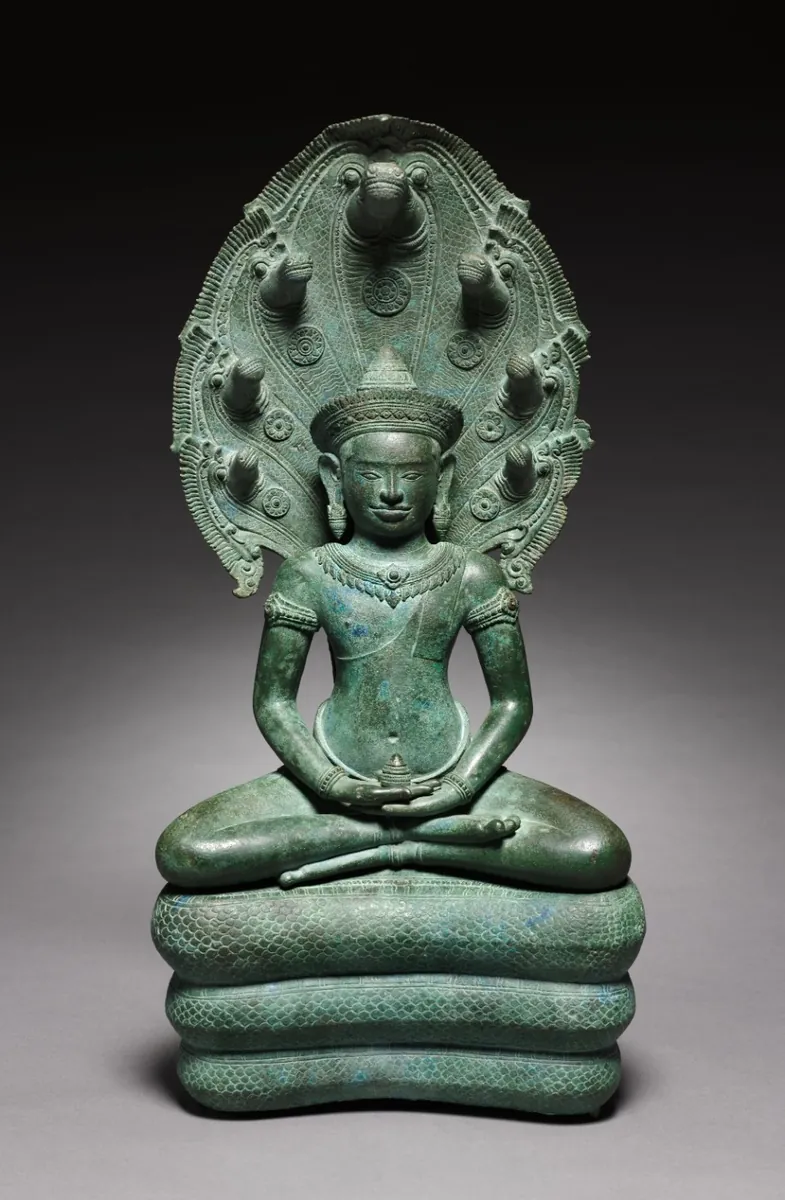
The third serpent is Buddhist. In the Udāna (2.1) and the Vinaya’s Mahāvagga (1.3), a storm blows for seven days after the Buddha’s awakening. The nāga king Mucalinda wraps seven coils around him and spreads his hood over his head. When the sky clears, the serpent takes the form of a young man and bows. Here the snake shelters an awakening that has already happened.
The Ṣaṭ-cakra-nirūpaṇa also gives the lower centres animals that carry their seed-syllables. In the Mūlādhāra the elephant Airāvata carries laṃ. In the Svādhiṣṭhāna the makara, a water creature, carries vaṃ. In the Maṇipūra a ram carries raṃ. In the Anāhata a black antelope carries yaṃ. In the Viśuddha an elephant carries haṃ. The Ājñā has no animal at all, which feels right. By then there is nothing left to ride.
Above the Ājñā the text places Haṃsaḥ, and it says the individual self in the heart is “like Haṃsa”. The haṃsa, the swan or wild goose, was said to separate milk from water, so it stands for discernment and for the soul. Realised sages are called Paramahaṃsa, “supreme swan”. The effortless haṃsa breath is ajapā, the unspoken mantra.
Then the peacock. It is the mount of Skanda, also called Kārttikeya. Peacocks really do eat snakes. Around the turn of the first millennium the Buddhist teacher Dharmarakṣita, a teacher of Atiśa, wrote a mind-training text called The Poison-Destroying Peacock. The peacock thrives in a poisonous grove, as a practitioner can thrive on afflictions.
And the bees. They hum in Pūrṇānanda’s verse, and among the inner sounds of the Haṭha Yoga Pradīpikā (4.85–86). Bhrāmarī prāṇāyāma, the humming breath, is named after the bee.
Serpents and dragons of other lands
In Egypt the rearing cobra, the uraeus, sits on the royal brow. She is Wadjet, protector of Lower Egypt and linked with the Eye of Ra, and a cobra on a papyrus stem is known from Predynastic times. Reading her as a “third eye” or a risen Kuṇḍalinī comes from Theosophy, above all Leadbeater’s The Chakras (1927), not from any Egyptian text.
The staff with two snakes is the caduceus, the wand of Hermes, herald of the gods. We admit a soft spot for it here, since the Institute’s founder shares the god’s name. In the Homeric Hymn to Hermes, Apollo promises the young god “a splendid staff of riches and wealth”, golden, with three branches. The snakes came later. Reading them as iḍā and piṅgalā, with the wings as the crown, is a modern idea, and no ancient Greek writer says so. Still, a messenger’s staff that passes between worlds is not a bad emblem for a teacher, and we carry it lightly.
It is a different thing from the staff of Asclepius, the healer’s rod with one snake and no wings. The confusion between them dates from 1902, when the US Army Medical Corps adopted the caduceus.
Older than both is Ningishzida, the Mesopotamian “Lord of the true tree”, attested around 2600–2350 BCE. A steatite libation vase made for Gudea of Lagash, about 2120 BCE and now in the Louvre, shows two serpents twined around a rod, flanked by winged dragons. It is often called the oldest caduceus-like image; any link to Kuṇḍalinī is modern.
In the Bible, Moses makes Nehushtan, the bronze serpent. “And Moses made a serpent of brass, and put it upon a pole” (Numbers 21:9), and whoever had been bitten and looked at it lived. Hezekiah later broke it because incense was burned to it (2 Kings 18:4). John’s Gospel takes the image up again: “as Moses lifted up the serpent in the wilderness, even so must the Son of man be lifted up” (John 3:14). Reading it as Kuṇḍalinī is modern and esoteric.
In Mesoamerica the feathered serpent, Quetzalcōātl to the Aztecs and Kukulkan to the Maya. The earliest image is usually traced to La Venta Stela 19, Olmec, about 900 BCE, and there is a great temple to him at Teotihuacan. He is linked with wind, the morning star, learning and priesthood. At Chichén Itzá, the late-afternoon sun around the equinoxes throws a rippling shadow down the stairway of El Castillo that meets a carved serpent head at the foot. The effect is real; whether it was intended, nobody knows.
In Aboriginal Australia, the being that English speakers have called the Rainbow Serpent since the anthropologist Radcliffe-Brown used the phrase in 1926 has many names in many languages: Ngalyod among the Kunwinjku, Yurlunggur in north-east Arnhem Land, the Wagyl of the Noongar in the south-west, and many more. It is a creator being of water, land and law. Much of this knowledge is restricted and belongs to its custodians, so we will not draw it into a chakra diagram.
The ouroboros, the serpent swallowing its tail, appears in the Enigmatic Book of the Netherworld in Tutankhamun’s tomb, in the fourteenth century BCE. In the alchemical Chrysopoeia of Cleopatra it encircles the words hen to pan, “the all is one”.
Last, the Chinese dragon chasing a pearl, a motif from about the Tang dynasty onward. In Daoist inner alchemy, neidan, Dragon and Tiger are a pair: spirit and breath, yang and yin, the fire of the heart and the water of the kidneys. It is a different map from the yogic one, with its own logic.
Lotuses and roses
If the serpent is the power, the lotus is where she opens. Every centre in the Ṣaṭ-cakra-nirūpaṇa is a padma, a lotus, with its own petals and letters, and the crown has a thousand. A lotus roots in mud, grows up through dark water and opens clean in the sun. And Kuṇḍalinī herself is “fine as the fibre of a lotus stalk”: the flower is not only where she goes, but something like what she is made of.
Egypt had its own sacred water lily, the blue lotus, Nymphaea caerulea. The young god Nefertem rises from the primal waters in its flower and is called “Water-Lily of the Sun”.
In Europe the flower of the inner life is the rose. Luther’s seal, designed in 1530, sets a heart and a cross inside a white rose. The Rosicrucian manifestos followed a century later: the Fama Fraternitatis in 1614, the Confessio in 1615 and the Chymical Wedding in 1616. Later esoteric writers matched roses to chakras. The manifestos themselves do not.
The axis and the tree
Pūrṇānanda begins with the spine. In his first verse the moon, Śaśī, moves on the left of the Meru and the sun, Mihira, on the right, with the suṣumnā between them, and the commentary explains that Meru here is the backbone. Meru is the mountain at the centre of the world, so each of us carries the world’s axis inside.
The haṭha texts give the two side channels the names of rivers: iḍā is Gaṅgā and piṅgalā is Yamunā. In the Rāmāyaṇa (Bāla Kāṇḍa 43), when Gaṅgā falls from heaven with force enough to shatter the earth, Śiva catches her in his matted locks and lets her down gently.
Śiva’s triśūla, the trident, is often read as the three channels joined in one shaft. That is interpretation, not the old texts.
Egypt’s djed pillar is the hieroglyph for “stability”, understood as the backbone of Osiris. In the rite of Raising the Djed it was set upright, linked with Osiris rising. Reading it as energy climbing the spine is, again, modern.
In the Norse poems the world-ash Yggdrasil has the dragon Níðhöggr gnawing at a root and an eagle sitting at the top, with the squirrel Ratatoskr running messages between them (Grímnismál, around stanzas 31–35; Gylfaginning 16). Serpent at the root, bird at the crown. The comparison is ours, not the poet’s.
The Kabbalistic Tree of Life grows from different soil. Its sefirot appear in the Bahir and the Zohar, and the classic diagram was first printed in 1516, in Portae Lucis. Matching the sefirot to the cakras is modern Hermetic work.
Jacob dreamed of “a ladder set up on the earth, and the top of it reached to heaven: and behold the angels of God ascending and descending on it” (Genesis 28:12). Reading the ladder as the spine is modern.
And in China, the Neijing tu, carved on a stele at the White Cloud Temple in Beijing in 1886, shows the body as a landscape with the spine as a mountain and a water wheel raising energy from the lower body. It is often equated with Kuṇḍalinī. The maps differ: the Daoist microcosmic orbit circles up the back and down the front, in its own terms.
Fire and light
The Ṣaṭ-cakra-nirūpaṇa paints the inner body in light. Iḍā is lunar and on the left. Piṅgalā is solar and on the right. Suṣumnā, between them, is fiery and red. And Kuṇḍalinī shines like lightning.
The fire image most often drawn in from elsewhere is Pentecost. “And there appeared unto them cloven tongues like as of fire, and it sat upon each of them” (Acts 2:3). Some modern writers have compared this with her arrival at the crown. Luke does not, and Christians understand it as the gift of the Holy Spirit.
Some popular claims that aren’t true
A few stories travel from book to website without anyone checking.
- That the caduceus “always” stood for Kuṇḍalinī. No ancient source says so.
- That Ningishzida goes back to 4000 BCE. He is attested about 2600–2350 BCE.
- That the Maya deliberately designed the equinox serpent. It may be so, but nobody knows.
- That the uraeus was the Egyptian third eye. That idea is Theosophical.
- That a lion or a white elephant is among the cakra animals. Neither is in the text.
- That Kuṇḍalinī appears in the early Upaniṣads. She does not; a possible first mention is in the Tantrasadbhāva, around the eighth century CE.
- That a Kuṇḍalinī Upaniṣad shows her biting her own tail. It does not.
- That the rainbow chakra colours are ancient. They are a twentieth-century creation.
Add one more: that Moctezuma took Cortés for Quetzalcōātl. That is most likely a post-Conquest story.
What the symbols still teach
The serpent teaches patience. Śeṣa remains when everything else has gone. She lies coiled until she is ready, and no amount of pushing changes that.
The lotus teaches that the mud is not the enemy. What grows through dark water opens clean.
The churning teaches order: poison first, then nectar.
The swan teaches discernment, the bee listening. Gaṅgā teaches that what descends with great force needs to be received gently.
And the comparisons from other lands, held honestly, teach something too. People everywhere have looked at the spine, the breath and the fire in the heart and reached for a snake, a tree, a flower or a flame. They were not all describing Kuṇḍalinī, but they were describing the body as a place where heaven and earth meet.
When you next sit, borrow one image and let it keep you company: the coiled serpent in the root lotus, the thousand petals, the messenger’s staff if you like. Then let it go, and stay with what it pointed to.
Sources & further reading
- Pūrṇānanda, Ṣaṭ-cakra-nirūpaṇa (1577), trans. Arthur Avalon in The Serpent Power (1919). Read online
- Svātmārāma, Haṭha Yoga Pradīpikā, trans. Pancham Sinh (1914). Verse numbers can differ by one between editions. Read online
- Arthur Avalon, The Serpent Power, Introduction ch. 5. Read online
- Homeric Hymn to Hermes, trans. Hugh G. Evelyn-White (1914). Read online
- King James Bible: Numbers 21:8–9, 2 Kings 18:4, John 3:14, Genesis 28:12, Acts 2:3
- Udāna 2.1 and Vinaya, Mahāvagga 1.3, on Mucalinda
- On the Rainbow Serpent, its many names and the term’s history. Read online
- Paul S. C. Taçon and colleagues, “Birth of the Rainbow Serpent in Arnhem Land rock art and oral history”, Archaeology in Oceania 31 (1996)
- On Luther’s seal (1530) and his letter to Lazarus Spengler. Read online