
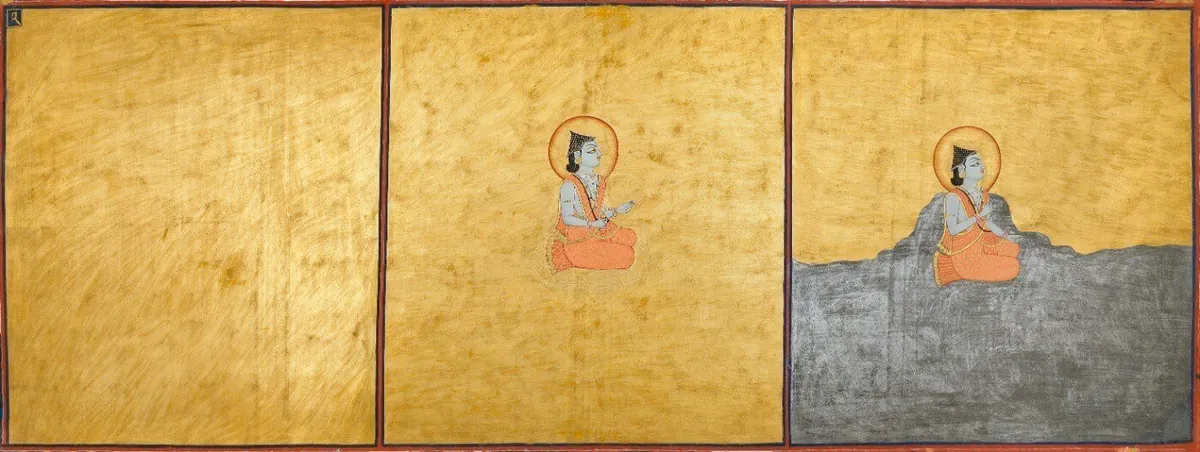
A woman by the sea
Most of the classical texts picture Kuṇḍalinī being coaxed upwards. The yogi purifies the channels, locks the breath, squeezes and fans the fire, and only after long effort does she stir in the root lotus and begin to climb. Sahaja Yoga turns that picture around. It says she can rise by herself, gently, in a single evening, and that the work comes afterwards.
The movement grew around one woman. Nirmala Salve was born on 21 March 1923 in Chhindwara, in central India, to a Hindu father and a Christian mother. As a young woman she spent time at Gandhi’s ashram and took part in the struggle for independence; she was jailed in 1942 during the Quit India Movement. She studied medicine for a while in Ludhiana and Lahore, and shortly before independence she married Chandrika Prasad Srivastava, a senior civil servant who later led the International Maritime Organization in London.
Her followers call her Shri Mataji Nirmala Devi. The movement dates its beginning to 5 May 1970 at Nargol, a beach on the Gujarat coast. She had been meditating there by the sea, and she later described how she witnessed the opening of the universal Sahasrara. From that moment, as Sahaja Yogis tell it, the crown of humanity was open, and collective awakening became possible.
Public programmes followed in India from 1972 and in England from 1975. From London the teaching spread across Europe and reached North America by the mid-1980s. She died in Genoa on 23 February 2011, and the movement continues in many countries.
Realisation first
Sahaja is a lovely word. It means born with you, natural, effortless. Saha is “with”, ja is “born”. In Sahaja Yoga it carries the whole teaching: Kuṇḍalinī awakening is a birthright, something already folded into every human being, waiting for the right moment.
So the order of things is reversed. In most yogic schools, realisation is the far end of a long road. Here they call the first awakening “Self-realisation” and offer it at the very start, often at a free introductory evening. A newcomer sits with hands open on the lap, a leader guides the group through a short, simple sequence, and many people report a quietness, a coolness in the hands, or simply a pause in the usual stream of thought.
That pause is the point. The state the movement aims at is called thoughtless awareness, nirvicāra, or more plainly, mental silence. Awake, alert, present, and not thinking. Practitioners describe meditation as returning to that state and gradually widening it, until it starts to colour ordinary life.
We find something honest in this. Plenty of people work hard at meditation for years and treat stillness as a summit they may one day reach. Sahaja Yoga says the summit is closer than you think, and that effort can get in the way. You may agree or not. It is worth hearing.
The cool breeze
The signature experience of Sahaja Yoga is a cool breeze. Practitioners call the subtle current behind it Paramchaitanya, which they describe as the all-pervading power of divine love. When Kuṇḍalinī rises through the central channel and pierces the crown, they say this current can be felt as a cool wind on the palms of the hands and above the head, at the soft place on the skull where the fontanelle once was. The old texts call that spot the Brahmarandhra, the opening of Brahman, at the Sahasrāra.
Sahaja Yogis call the sensations “vibrations”, and they use them as a kind of instrument. A cool breeze flowing evenly on both palms is read as a sign that the subtle system is clear. Heat or tingling, by contrast, is read as a sign that something in the system is blocked and needs attention.
It is worth saying plainly that this is a teaching about inner perception, and it has not been tested in any rigorous way as a diagnostic method. Many people do feel something real in their hands during meditation. What that something means is a question of interpretation, and different traditions read it differently.
We like the humility of starting with the body. A cool breeze on the hands is modest. It is not a vision, and it does not make anyone special. It is a small sign that the system is settling, and that is a useful kind of sign to look for.

Left, right, centre and the Void
The Sahaja map of the subtle body is built from the classical one, with its own emphases. There are three channels. The left channel, iḍā, is linked with emotion, desire and the past. When it dominates, the movement says, a person can sink into lethargy, sadness and self-pity. The right channel, piṅgalā, is linked with action, planning and the future. When it dominates, a person becomes dry, driven and critical. The central channel, suṣumnā, is the path of Kuṇḍalinī, and balance between the two sides is what lets her rise.
This is a practical psychology, and it is easy to recognise yourself in it. Most of us lean one way. Some of us lean one way in the morning and the other by night.
Around the navel centre, which they call Nabhi, lies an area the movement names the Void, or Bhavasāgara, the ocean of illusion. It represents the inner guru principle, the part of us that can become our own teacher. Sahaja Yoga honours ten “primordial masters” in this region, among them Moses, Lao-tse, Mohammed, Guru Nanak and Sai Baba of Shirdi. Each chakra also has its presiding deity, starting with Shri Ganesha at the Mooladhara, and the system draws freely on Hindu, Christian and other sacred figures.
Shri Mataji also linked the subtle body to modern physiology. She connected suṣumnā with the parasympathetic nervous system, and iḍā and piṅgalā with the sympathetic system. The psychoanalyst and writer Sudhir Kakar described this as a neurological veneer laid over traditional Tantric ideas. We would put it gently: the comparison can help people from a scientific culture feel at home, but it is a metaphor, and the nāḍīs are not nerves.
What practitioners do
Daily practice is simple, which is part of the appeal. A few of the main elements:
Footsoaking. The practitioner sits with both feet in a bowl of salted water for five to ten minutes, usually while meditating, and then throws the water away. It is understood as a cleansing, a way of letting the day’s accumulations drain off.
The bandhan. A protective gesture. The right hand arcs from the left hip, over the head, to the right hip, seven times, like drawing a rainbow over yourself.
Raising the Kuṇḍalinī. The left hand faces the body and moves slowly upward, from the lower belly to the top of the head, while the right hand circles around it. At the top a small “knot” is tied in the air. This is done three times. It is not meant to force anything. It is more like an invitation, a way of placing attention along the central line.
The candle. Many practitioners meditate with a lit candle, often in front of a photograph of Shri Mataji, and say it helps to clear the Agnya, the Ājñā centre between the eyebrows. Some meditate before her photograph as a matter of devotion.
Collective meditation. Meeting in a group is central to the movement, and the regular group meditation is where most newcomers first arrive.
Introductory classes are free, and always have been. The movement does charge for some international pujas, its larger devotional gatherings, and some former members have described other costs over time. Even so, the free door is real, and that is not common.
What the research shows
Sahaja Yoga is one of the few Kuṇḍalinī-based practices with a randomised trial behind it, and it deserves to be described carefully.
In 2011 Ramesh Manocha and colleagues in Australia published a trial with 178 full-time workers. Over eight weeks, one group learned “mental silence” meditation in the Sahaja style, a second group learned a relaxation method, and a third waited. The meditation group improved more than both other groups on a measure of psychological strain at work and on a measure of low or depressed mood. The authors suggested that the reduction of thought itself might matter, beyond simple relaxation.
Earlier, the researchers Aftanas and Golocheikine in Novosibirsk recorded the brain activity of experienced Sahaja meditators. In studies published in the early 2000s they found increases in theta and lower alpha activity over the front and midline of the head during meditation, linked with reported positive emotion and inwardly focused attention. One of the studies also found a drop in the complexity of the EEG signal, which the authors read as the brain switching off networks that were not needed.
This is encouraging, and it is also limited. One trial is one trial. Workplace stress and low mood are real outcomes, but they are not Kuṇḍalinī awakening, and a brain-wave pattern does not tell us what a person is experiencing inwardly. The movement has at times claimed much more, including the healing of serious illness. Those claims have not been independently verified, and nobody should replace medical care with meditation of any kind.
Criticism, and keeping your own eyes open
A fair picture has to include the other side. Shri Mataji declared herself a divine incarnation, the Ādi Śakti, identified also with the Holy Spirit, and many followers worship her as such. For some people that is the heart of the practice. For others it is where they step back.
Some scholars and former members have described the movement as a cult or a high-demand new religious movement. They report pressure, secrecy, close control of members’ lives, and in some accounts strain on family ties. France listed Sahaja Yoga in its 1995 parliamentary report on cults. In 2005 Belgium’s official advisory body on harmful sectarian organisations warned that its recruitment could be misleading. Sahaja Yoga took the matter to court and lost on appeal in 2011.
At the same time, many people meet the movement through a free evening, find a real quietness there, and carry it into their lives without any trouble at all. Both of these things are true.
So how do you stay clear in any group, this one or ours? A few questions help. Can you ask hard questions and get straight answers? Can you leave without being shunned? Is your own inner sense of things respected, or slowly replaced by the group’s language? Are your family, your money and your sleep still yours? If the answers start to drift, notice it. The practice can stay with you even if the group does not.
What we appreciate, and where we differ
As an institute, we honour grace and descent. Śaktipāta, the falling of power from above, is part of our own work, so we recognise a great deal in Sahaja Yoga. The trust that awakening can be given. The gentle, unforced way of inviting Kuṇḍalinī upward. The emphasis on silence over spectacle. Free evenings. Footsoaking, which is so ordinary and so grounding. And the insistence that she is a mother, not a machine to be operated.
Where we differ is mostly a matter of emphasis. In Sahaja Yoga, the founder sits at the centre: her words, her photograph and her divinity are the reference point for everything. We work differently. We believe the living relationship between student and teacher matters more than devotion to any one founder. A teacher who is here, who can see you in this season of your life, who can say “slow down” or “this is not for you yet”, offers a discernment that a photograph cannot.
We also place a little more weight on the long middle of the path. An awakening, however it comes, is a beginning. The years of integration that follow, with their hard phases as well as their bright ones, need guidance that is personal and responsive.
None of this makes Sahaja Yoga wrong. If the cool breeze has found you there, we are glad. Keep your eyes open, keep your feet on the ground, and keep listening to what is quiet in you.
Sources & further reading
- Wikipedia, Nirmala Srivastava (early life, Quit India Movement, marriage). Read online
- Wikipedia, Sahaja Yoga (founding, practices, the Belgian case and scholarly views). Read online
- Manocha R., Black D., Sarris J., Stough C., “A randomized, controlled trial of meditation for work stress, anxiety and depressed mood in full-time workers”, Evidence-Based Complementary and Alternative Medicine (2011), article 960583. Read online
- Aftanas L.I., Golocheikine S.A., “Human anterior and frontal midline theta and lower alpha reflect emotionally positive state and internalized attention”, Neuroscience Letters 310 (2001). Read online
- Aftanas L.I., Golocheikine S.A., “Non-linear dynamic complexity of the human EEG during meditation”, Neuroscience Letters 330 (2002). Read online
- Pūrṇānanda, Ṣaṭ-cakra-nirūpaṇa (1577), trans. Arthur Avalon in The Serpent Power (1919). Read online
- Abhinavagupta, Tantrasāra and Tantrāloka ch. 5; notes by Mark Dyczkowski. Read online