
A number with a meaning
Several old texts give the same strange number. The Gheraṇḍa Saṃhitā, the Dhyānabindu Upaniṣad, the Haṃsa Upaniṣad and the Vijñāna Bhairava Tantra all say that a living being breathes 21,600 times in a day and a night.
Do the sum and it is surprisingly modest. A day has 1,440 minutes, so the figure works out at fifteen breaths a minute, or nine hundred an hour. That is within the range of a resting adult, though real breathing varies a great deal with age, health, effort and mood. Nobody needs to check it with a stopwatch.
It is worth being clear about age, too. The Gheraṇḍa Saṃhitā is usually dated to the late seventeenth century, and the yoga Upaniṣads that carry this teaching are medieval rather than Vedic. The idea is old, but it is not as old as the Vedas, and nothing is lost by saying so. A practice does not need to be ancient to be true.
Because the yogis were not counting for the sake of counting. They were pointing at something the breath is already doing, every minute of every day, whether we notice or not. The number is a way of saying: this has been going on all your life.
The mantra that says itself
According to the Gheraṇḍa Saṃhitā, the air comes in with the sound sa and goes out with the sound haṃ. So every breath, without any effort, repeats a mantra. The text calls it the Ajapā Gāyatrī: the prayer that is recited without being recited. Japa is repetition of a mantra; a-japā is the japa no one does.
The name is a deliberate honour. The Gāyatrī is the most revered mantra of the Vedas, recited at dawn and dusk for some three thousand years, and the word is also the name of a poetic metre. To call the plain breath a Gāyatrī is to say that the humblest thing you do, the thing you do even in your sleep, already belongs among the holiest.
The Dhyānabindu Upaniṣad agrees. The living self, it says, goes out with the letter ha and comes back in with the letter sa, and it utters this mantra 21,600 times in a day and a night. It calls this Ajapā Gāyatrī the constant giver of liberation to yogis.
Read the two syllables one way and you hear haṃsa, the swan. Read them the other way and you hear so’ham, “I am That” or “I am He”. That second phrase is old: the Īśa Upaniṣad closes with a prayer that ends in the words so’ham asmi, which Max Müller rendered as “I am what He is”.
The Kashmir tradition hears it the other way round. In the closing verses of the Vijñāna Bhairava, the breath goes out with sa and comes in with ha, and the text calls this unbroken recitation, 21,600 times in a day and night, the japa of the Goddess. Swami Lakshmanjoo taught that real japa begins when this natural breath is given more length and attention, not when it is merely repeated.
So the schools disagree on the direction. We find that rather lovely. They argue about which way the river flows and agree that it is a river of mantra. For practice we will follow the most common modern form, so on the in-breath and ham on the out-breath, which matches the Gheraṇḍa. If you were taught the reverse by a teacher you trust, keep it.
21,600 times a day, the breath says “I am That”. We only have to listen once.Golden Sight Institute
Why a swan
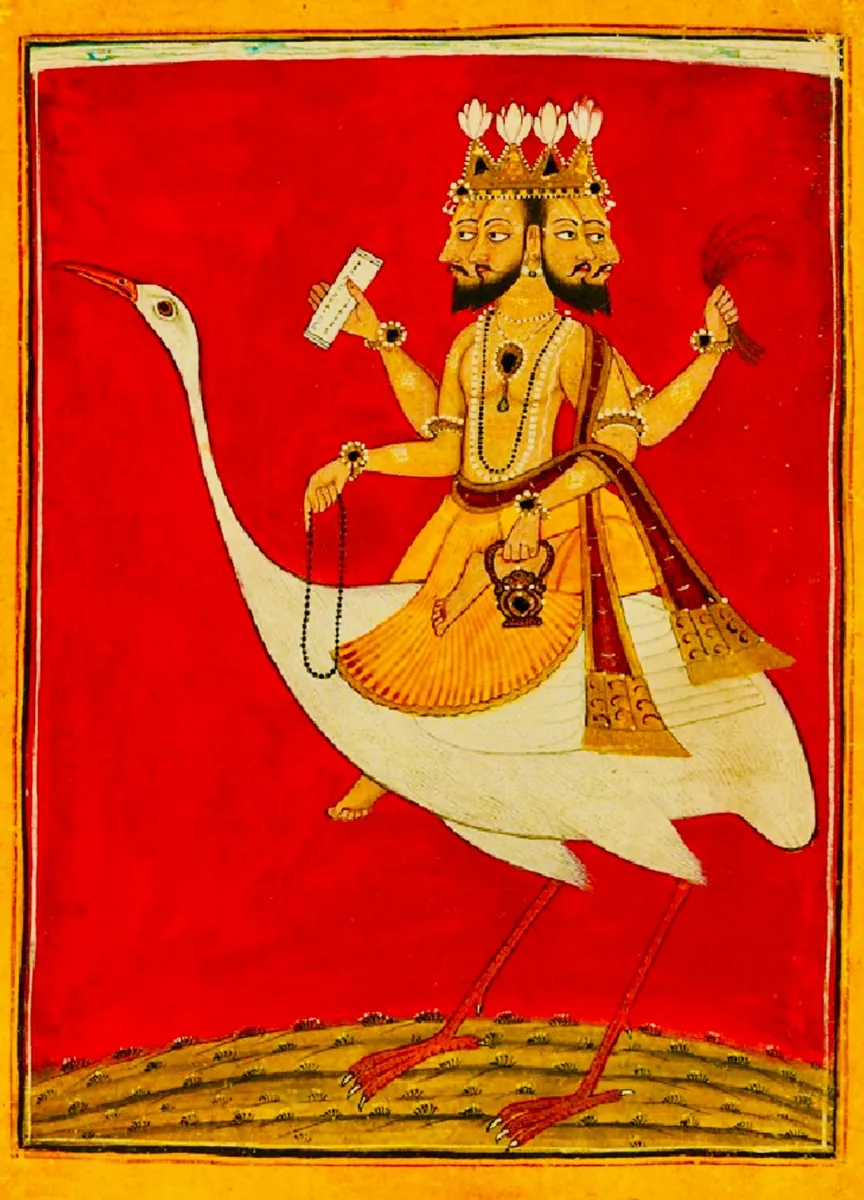
In Indian poetry the haṃsa, the swan or wild goose, is the bird that can separate milk from water. It became the emblem of discernment, of the soul that can tell the real from the passing. A realised sage is called a paramahaṃsa, a supreme swan.
The yogic texts carry the image inward. The Ṣaṭ-cakra-nirūpaṇa describes the individual self in the heart as being like Haṃsa, and it places Haṃsaḥ again above the Ājñā lotus between the eyebrows. The Haṃsa Upaniṣad takes the word apart like a mantra: haṃ is the seed, sa is the power, śakti, and so’ham is the pivot between them. It also describes an eight-petalled lotus at the heart, with the mind leaning towards a different tendency, towards virtue, sleep, cruelty, desire and so on, as it rests on each petal.
We like to think of it simply. Each breath is a wingbeat. The swan has been flying through you since your first in-breath and will fly out with your last.
The turning points
There is a second teaching hidden inside ajapā, and the Vijñāna Bhairava makes it explicit. Between the in-breath and the out-breath there is a turning point, and between the out-breath and the next in-breath there is another. In several verses near its beginning (24 to 27 in Jaideva Singh’s numbering), the text points to these places. When attention rests on the two points where the breath arises and returns, it says, a sense of fullness appears. When the breath neither goes out nor comes in, even for an instant, the centre opens.
This is very gentle. It does not ask for a long breath-hold. It asks you to notice the moment, already there, when the breath turns. Most of us rush past it thousands of times a day.
Try it once now, before reading on. Breathe in naturally. Notice the instant at the top where the in-breath has finished and the out-breath has not begun. Breathe out. Notice the instant at the bottom, the small resting place before the body asks for air again. Do not lengthen either pause. Just be present for it. Three breaths like this are enough to taste what the Tantra means.
The Gheraṇḍa adds its own observation. At rest, it says, the out-breath extends about twelve finger-breadths from the nose; it grows longer when eating and walking, and longer still in sleep and strenuous effort. The text holds that a breath which is calmer and shorter in its reach supports a long life. We would read that as the old yogis’ way of describing what most of us already know: a quieter breath goes with a quieter mind. It is not a medical claim, and we do not offer it as one.
How to practise, step by step
Set aside fifteen minutes to begin with. Morning or evening both work. You can sit, or lie on your back with a cushion under the knees.
Arrive. Let the body settle. Feel where it touches the floor or the chair. Let the jaw soften and the tongue rest.
Let the breath be natural. This matters. Do not deepen it, slow it or shape it. Ajapā is about hearing what the breath already does, not making it do something new. If you notice yourself controlling it, smile and let go again.
Hear “so” on the in-breath. Silently, without moving the lips or the tongue. Let the breath carry the sound, as if the syllable were already there in the air and you were tuning in to it.
Hear “ham” on the out-breath. The same way. Some people find the “m” at the end hums softly in the chest or the head. Let it.
Notice the turning points. As the in-breath completes, notice the tiny pause before the out-breath begins. As the out-breath completes, notice the pause before the next in-breath. Rest in each for a moment, without holding anything.
Let the mantra thin out. After some minutes the syllables may become fainter, until there is only the breath and the listening. That is fine. That is in fact the direction of the practice. If thought takes over completely, return to “so” and “ham”.
Close. Take one or two fuller breaths, with a slow out-breath of 7 or 8 counts. Feel the body again. Open the eyes.

Taking it into the day
The real beauty of ajapā is that it does not need a cushion. It is a practice made for ordinary life.
Choose two or three small anchors in your day: the kettle boiling, the moment you sit down at a desk, a red traffic light, the last thing before sleep. At each anchor, listen for so’ham for three breaths. That is all. Nobody around you needs to know.
Some people like to pair ajapā with a mālā at first, moving one bead with each full breath. This helps keep attention steady, and it is a way of honouring the old idea that the breath itself is japa. After a while you may find you do not need the beads.
Over weeks, something shifts. You begin to notice the breath more often without deciding to. A difficult conversation has, somewhere at its edge, a swan still flying. That is not a technique working. It is attention slowly coming home.
When it does not go smoothly
Nearly everyone meets a few of the same snags, so it may help to name them.
“I keep controlling the breath.” This is the most common one. The moment we watch the breath, we start to manage it. Do not fight this. Let the syllables lead instead: listen for “so” and “ham”, and let the breath do whatever it wants underneath. Over days, the managing relaxes by itself.
“The syllables don’t match my breath.” Sometimes the in-breath is short and the out-breath long, or the other way round. Let each syllable stretch or shrink to fit. The breath sets the pace; the mantra follows.
“I fall asleep.” If you practise lying down at night, that is not a failure at all; many people use ajapā to fall asleep, and it is a kind way to end the day. If you want to stay awake, sit up and keep the eyes slightly open, resting on the floor in front of you.
“Nothing happens.” Good. Ajapā is not meant to produce events. Its fruit is usually noticed later and sideways: you react a little more slowly, you sleep a little better, the breath catches your attention more often on its own.
Why it matters for Kuṇḍalinī
The breath is the bridge between the body we can feel and the subtle body we cannot yet see. In haṭha teaching, prāṇa moves restlessly through the left and right channels, iḍā and piṅgalā, for most of our lives. When the breath settles and the mind settles with it, the old texts say, that movement slowly turns towards the central channel, the suṣumnā.
The Gheraṇḍa notes that the haṃsa is set in motion in three places: the root lotus, the heart and the space between the eyebrows. Kuṇḍalinī lies coiled in the root lotus, around the Svayambhū-liṅga, covering the door of the central channel. She is not woken by force in this practice. Ajapā is perhaps the gentlest way of inviting her, because it asks for nothing except attention. In our experience she often responds to that kind of quiet more readily than to effort.
A word of care. For some people, especially those who carry trauma or anxiety, paying close attention to the breath can feel unsettling at first. If you notice panic, tightness or a sense of not getting enough air, open your eyes, feel your feet on the floor and let the practice go for the day. You might return to it later with the eyes open and for only a minute or two, or try listening to a sound outside you instead. If breath awareness reliably brings distress, please talk to a doctor or a mental-health professional as well as a teacher. There is no prize for pushing through.
And if the energy is already strongly active, ajapā is usually one of the kinder practices to keep, since it adds no force. Even so, if things feel too intense, step back and ground. The swan will still be there tomorrow.
Sources & further reading
- Gheraṇḍa Saṃhitā, chapter 5. Read online
- Dhyānabindu Upaniṣad and Haṃsa Upaniṣad. Read online
- Vijñāna Bhairava Tantra, verse concordance (Jaideva Singh numbering). Read online
- Lakshmanjoo Academy, on automatic recitation (VBT 155–156). Read online
- Pūrṇānanda, Ṣaṭ-cakra-nirūpaṇa (1577), trans. Arthur Avalon in The Serpent Power (1919). Read online
- Haṃsa Upaniṣad, trans. K. Narayanasvami Aiyar, in Thirty Minor Upaniṣads (1914). Read online
- Īśa Upaniṣad 16, trans. F. Max Müller (1879). Read online