
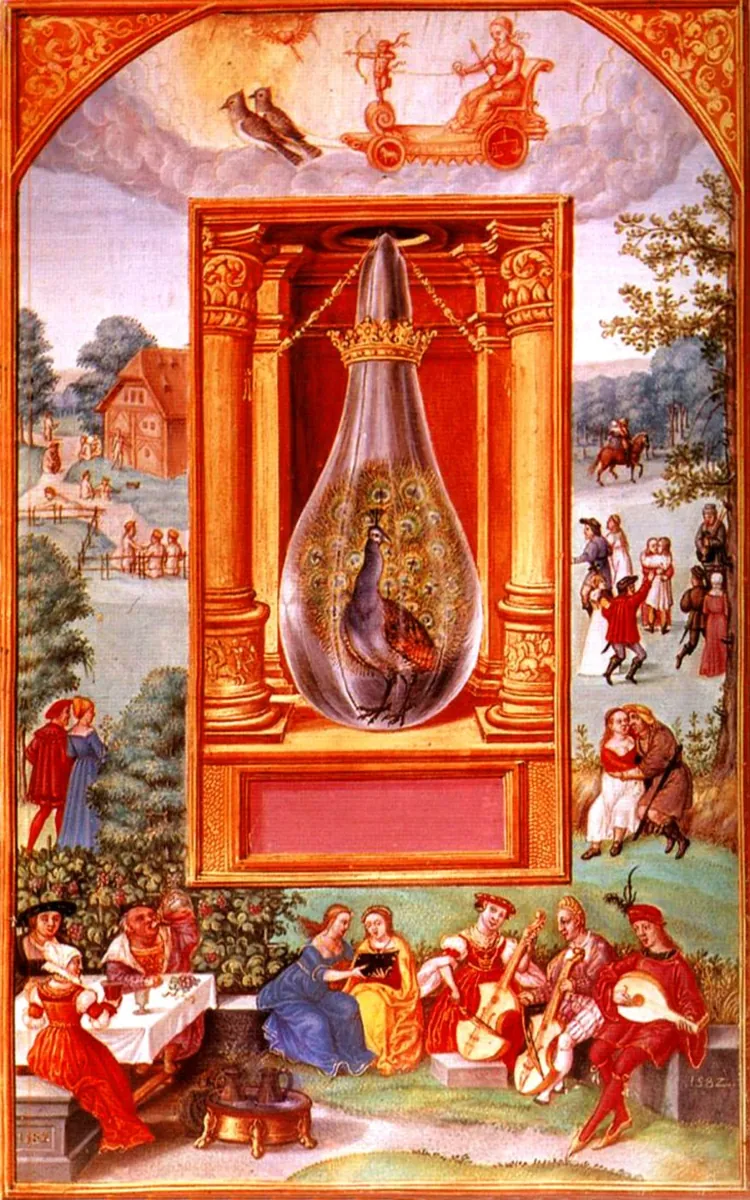
The picture we all know
Red at the root, orange below the navel, yellow at the solar plexus, green at the heart, blue at the throat, indigo between the eyebrows and violet at the crown. It is on posters, crystals, yoga mats and phone apps. Most people have no idea it is fairly new.
We are not writing this to spoil anyone’s yoga mat. We have used the rainbow ourselves, and we will say later why it still has a place. But we think anyone who loves this path deserves to know where the pictures come from. The old yogis left us something stranger and richer than seven stripes, and it would be a pity to lose it.
So this is a short history in three parts: what the classical text actually says, how many centres the older traditions counted, and how the rainbow arrived.
What the old text actually says
Almost every modern picture of the chakras goes back, one way or another, to a single Sanskrit text: the Ṣaṭ-cakra-nirūpaṇa, “the description of the six centres”, written by Pūrṇānanda in Bengal in 1577 and translated by Arthur Avalon in The Serpent Power in 1919. Pūrṇānanda describes each lotus with real care, and his colours are nothing like a rainbow.
| Lotus | Classical colour | Modern rainbow |
|---|---|---|
| Mūlādhāra | Crimson petals | Red |
| Svādhiṣṭhāna | Vermilion | Orange |
| Maṇipūra | The colour of heavy-laden rain-clouds | Yellow |
| Anāhata | Red, like the bandhūka flower | Green |
| Viśuddha | Smoky purple | Blue |
| Ājñā | White, like the moon | Indigo |
| Sahasrāra | Whiter than the full moon | Violet |
Look at that list for a moment. The two lower lotuses are reds, the navel is dark as a monsoon sky (the commentator glosses it simply as “of a dark hue”), the heart is red again, the throat is a smoky purple, and the top two are white. If you tried to turn that into a rainbow you would fail at the third step.
A word on translation. Colour words rarely cross languages cleanly. Avalon’s “crimson” for the root lotus renders the Sanskrit śoṇa, which the commentator Kālīcaraṇa explains as the crimson of the red lotus. Sanskrit poets compare colours to flowers, clouds, jewels and fire rather than naming abstract hues, so every English rendering is already a small interpretation. Even so, there is no reading of these words that turns them into a spectrum.
The heart is the most surprising for most people. We are so used to a green heart chakra that a red one feels wrong. But the bandhūka is a small tropical flower of shining red, and Pūrṇānanda chose it on purpose. The heart lotus glows.
Colours inside the colours
And that is only the petals. Each lotus is a whole small world, and every part of it has its own colour.
The letters on the petals are coloured too. On the four crimson petals of the root they are golden. On the vermilion lotus above, they shine like lightning. On the dark navel lotus they are the colour of the blue lotus. On the red heart they are vermilion, on the smoky throat crimson, and on the white lotus between the brows they are white as well. In the thousand-petalled lotus the commentator says the letters are white, and its filaments are tinged with the colour of the young sun.
Inside each lotus sits the region of an element, with its own shape and shade. At the root there is a shining yellow square of earth, where the elephant Airāvata carries the seed-syllable laṃ. In the second lotus a white half-moon of water carries vaṃ on a makara, a water creature the footnotes compare to an alligator. At the navel there is a red triangle of fire, bright as the young sun. In the heart the region of air is like smoke. At the throat the region of ether is circular and white like the full moon.
Then there are the deities, each with a complexion of their own. In the root lotus the Śakti Ḍākinī is red, with brilliant red eyes, radiant as many suns rising at once. At the navel, Rudra is a pure vermilion, yet looks white because his body is smeared with ash. In the heart the Śakti Kākinī is yellow, “like unto new lightning”. Between the brows the Śakti Hākinī has six faces, each like a moon.
Notice how often the text reaches for light rather than pigment: lightning, the young sun, the autumn moon. These are not paint-box colours. They are colours that glow, the way things glow in deep meditation or in a dream. We find that more helpful than any chart. It tells you what kind of seeing the old yogis were practising.
The old picture is far richer, and far stranger, than seven neat stripes. It was never meant to be a colour code. It was meant to be meditated on, slowly, one detail at a time, until the inner image came alive.
Not always seven, not always these
The rainbow brings another assumption with it: that there are seven chakras, always and everywhere. That is not true either.
Even Pūrṇānanda’s own title speaks of six centres. The thousand-petalled lotus above the head is described separately, as something beyond them. Older traditions counted differently again. Buddhist tantric texts from around the eighth century usually describe four or five centres. The Netra Tantra teaches a system of six, the Kaulajñāna-nirṇaya one of eight. The Kubjikāmata Tantra, from the Kaula school devoted to the goddess Kubjikā, is often named as the first text with the familiar six-plus-one arrangement.
In other words, the number seven is not a law of nature. It is one tradition’s count, which happened to meet a Western love of sevens: seven planets, seven days, seven notes, seven colours.
None of this makes the system less true. It makes it alive. Different schools, working with different practices and different goddesses, mapped the inner body in different ways. Pūrṇānanda’s map won out in the modern world mostly because Avalon translated it, and because it is so beautifully detailed.
Where the rainbow came from
The rainbow sequence grew out of Western esoteric writing, and the story is more tangled than most books admit.
In the 1880s Helena Blavatsky and the early Theosophists were already writing about seven centres and linking them with nerve plexuses. In 1927 the Theosophist and clairvoyant C. W. Leadbeater published The Chakras, and his illustrations of spinning, glowing wheels shaped Western imagination for the rest of the century. Some sources, including the Wikipedia article on chakras, credit Leadbeater with the seven rainbow colours.
But read Leadbeater himself and the picture is different. His root centre is “alternately red and orange in hue”. His heart centre is a “glowing golden color”, not green. His brow centre is half rose and half purplish-blue, and his crown is chiefly violet with all sorts of other hues. He even replaced the Svādhiṣṭhāna with a spleen centre that, he admitted, is not found in the Indian books. The nearest thing to a rainbow in his system is the six petals of that spleen centre, coloured red, orange, yellow, green, blue and violet.
Other strands were added in the same decades. In 1928 an American yogini born Amber Steen, who wrote as Cajzoran Ali, published what Leland identifies as the first book to link the chakras with the endocrine glands, a pairing still repeated everywhere. In 1932 Carl Jung gave a seminar in Zürich with the Indologist Wilhelm Hauer, reading the cakras as stages in the growth of the psyche; it was published in English only in 1996. Each of these writers added something. None of them was simply passing on what the Sanskrit said.
The historian Kurt Leland, who has traced these sources in detail, describes the Western chakra system as an “unintentional collaboration” of many hands. By his account, single colours in spectrum order were being given to the chakras in the 1930s, sometimes seven including indigo, sometimes six plus white. Colour healers in America and Britain took up the rainbow list. Then in 1977 Ken Dychtwald, a bodyworker at the Esalen Institute in California, brought together the rainbow colours, the endocrine glands and a list of psychological qualities for each centre. Leland dates the familiar package to that year.
Even the colour indigo has a history. Isaac Newton first divided the spectrum into five colours, then added orange and indigo to make seven, matching the notes of the musical scale. So the “indigo third eye” owes more to an English physicist’s love of harmony than to any yogi.
From the 1980s onward the neat red-to-violet ladder spread through popular books and, later, the whole wellness world. It caught on, we suspect, because it is easy to remember and seems to fit the colours of light. It is tidy. The old texts are not.
Does it matter?
For a quiet meditation, honestly, not very much. If picturing a green heart helps you feel your heart, use it. Colour in meditation works on the imagination, and the imagination is a real door.
But it matters for understanding. When you meet the classical colours, you are meeting the inner vision of yogis who wrote down what they saw more than four hundred years ago. A heart lotus the red of a forest flower, a navel lotus dark as monsoon clouds. These are not mistakes to be corrected by the rainbow. They are a different and older way of seeing, and they deserve to be remembered on their own terms.
It also matters for honesty. When a teacher tells you the rainbow chakras are thousands of years old, you now know that is not so. That does not make the teacher bad. It does mean that we should hold every map lightly, including our own.
If you would like to try the older colours, here is a simple way. Sit comfortably and let the breath settle, with a slow out-breath of 7 or 8 counts. Bring your attention to the heart, and instead of green, picture a small lotus the red of a bright flower, glowing softly. Stay with it for a few minutes. Then let the image go and simply rest. Notice whether the feeling is different from the one you are used to. There is no right answer.
If any visualisation practice brings up strong anxiety, dizziness or distress, stop, open your eyes and ground yourself. If that keeps happening, it is wise to speak with a doctor or mental-health professional.
Holding both
We do not ask anyone to throw away the rainbow. It has helped many people find their way to the inner body, and that is no small thing.
We only ask that it be seen for what it is: a modern, Western, useful simplification, built over a century by many hands. Underneath it lies an older picture, crimson and vermilion and storm-cloud and moon-white, full of letters and animals and goddesses. That picture was drawn by people for whom every detail was an act of worship.
There is also something freeing in the older picture. A rainbow suggests a ladder, with the lower colours somehow worse than the higher ones. Pūrṇānanda’s lotuses do not work like that. Red returns at the heart; white appears only at the top, but the root is where the Goddess herself lies coiled. Every centre is sacred, and none is merely a step to be climbed past.
When we teach the chakras at the Golden Sight Institute, we try to keep both in view, and to say clearly which is which. The rainbow is a good doorway. The lotuses are the house.
Sources & further reading
- Pūrṇānanda, Ṣaṭ-cakra-nirūpaṇa (1577), trans. Arthur Avalon in The Serpent Power (1919). Read online
- On the history of the chakra colours. Read online
- Kurt Leland, “The Rainbow Body: How the Western Chakra System Came to Be”, Quest (2017), summarising his book Rainbow Body (Ibis, 2016). Read online
- C. W. Leadbeater, The Chakras (1927), as quoted in the Theosophy Wiki. Read online
- On Newton’s seven colours (Opticks, 1704). Read online
- Arthur Avalon, The Serpent Power, Introduction ch. 5. Read online